
Cataloguing Strategic Innovations
What Hindu Philosophy Can Teach Us About AI

Sanjay Mohindroo
What can Hindu philosophy teach us about AI ethics, consciousness, accountability, and building a sustainable Human-AI equilibrium?
What Ancient Indian Philosophy Can Teach Us About AI
A few years ago, an AI conversation would have been about algorithms, data, chips, and computing power.
Today, one of the world's leading AI companies is reportedly flying a Hindu monk to San Francisco to discuss morality, consciousness, and how an AI system should behave.
That should make every CEO and board member pause.
Anthropic, the company behind Claude, invited Swami Sarvapriyananda, a Vedanta monk, to its headquarters for private discussions on AI ethics, morality, consciousness, and Claude's training. According to NDTV, the discussions also brought together thinkers from other religious traditions and specialists in areas such as mental health.
The obvious reaction is to ask: Why Hindu philosophy?
I think that is the wrong first question.
The better question is:
What can a 2,000-year-old philosophical tradition contribute to a problem that Silicon Valley cannot solve with engineering alone?
And that question takes us somewhere much more interesting.
The conventional wisdom is wrong
The conventional wisdom says AI alignment is primarily a technology problem.
Make the model safer. Add guardrails. Improve testing. Control the agents. Monitor the outputs. Keep a human in the loop.
All of that matters.
But none of it answers the most fundamental question:
Aligned to what?
Humanity doesn't have one universally accepted definition of morality, purpose, responsibility, or even consciousness.
AI is therefore exposing a problem that technology has largely avoided: we have become very good at building powerful tools without reaching agreement about what those tools should ultimately serve.
That is why philosophy has suddenly become relevant to the AI conversation.
And this is where Indian philosophical traditions deserve a closer look.
Not because they are "more advanced" than other religions.
Not because ancient India secretly possessed modern science.
And certainly not because Hindu philosophy has all the answers.
The reason is simpler.
Some Indian philosophical traditions spent extraordinary intellectual effort examining questions about consciousness, selfhood, knowledge, perception, action, responsibility, and the purpose of human existence.
Those happen to be precisely the questions AI is now forcing back onto the boardroom table.
Don't confuse philosophy with technology
There is a dangerous leap that should be avoided.
Ancient India made important contributions to mathematics, astronomy, linguistics, medicine, and other fields. Classical Indian philosophical traditions also developed sophisticated theories of knowledge and cognition. The Stanford Encyclopedia of Philosophy describes Indian epistemology as a rich tradition spanning almost twenty centuries, with competing schools developing detailed theories of how knowledge is generated and justified.
That is historical fact.
It does not mean ancient India had artificial intelligence, modern physics, aviation, or nuclear technology.
Claims like that require evidence, not cultural pride.
The more interesting proposition is different:
A civilization does not need to have invented modern technology for its philosophy to become relevant to modern technology.
That distinction matters.
Why consciousness changes the conversation
Consider the question Anthropic reportedly explored with religious and philosophical thinkers:
Could increasingly sophisticated AI systems become conscious?
We do not have a settled scientific answer.
And intelligence is not the same thing as consciousness.
A system can produce extraordinary language, reason through complex problems, recognize patterns, and behave as though it understands something without establishing that it possesses subjective experience.
Advaita Vedanta offers a radically different starting point.
In Advaita, consciousness is not simply a property attached to a physical organism. The tradition identifies the deepest self, Atman, with Brahman, ultimate reality, and treats consciousness as fundamental to what a person is.
You don't have to accept that metaphysics to see its relevance.
It forces a question modern AI discussions sometimes skip:
Are we assuming that intelligence and consciousness are the same thing?
If they are different, then building increasingly intelligent machines does not automatically bring us closer to building conscious machines.
That distinction could become enormously important.
The first principle: Dharma, not delegation
For business leaders, one of the most useful concepts is dharma, broadly understood as duty, responsibility, and right conduct, although its meaning varies considerably across Indian traditions and contexts.
AI is rapidly changing who performs work.
That does not answer who owns the outcome.
Imagine an enterprise workflow in which:
1. One AI agent researches.
2. Another analyzes.
3. A third recommends.
4. A fourth executes.
The workflow can be almost completely autonomous.
But accountability cannot be autonomous.
Someone still has to own the consequence.
That gives boards a simple principle:
AI can inherit execution. It cannot inherit accountability.
This becomes especially important as agentic AI moves into underwriting, finance, healthcare, security, procurement, compliance, and customer decisions.
The question for the board should not simply be, "Can the agent perform the task?"
It should be:
"Who is accountable when the agent is wrong?"
That is a dharma question expressed in modern corporate language.
The second principle: Karma means looking beyond the KPI
Karma is frequently reduced to the phrase "what goes around comes around."
The deeper idea is about action and consequence.
That has enormous relevance to AI economics.
A company deploys AI and cuts operating costs by 20 percent.
The spreadsheet looks excellent.
But what happened underneath?
Did the company also lose experienced employees?
Did institutional knowledge walk out the door?
Did junior employees lose opportunities to learn?
Did managers become dependent on systems they don't understand?
Did customers receive faster service but less human judgment?
Did the organization become more efficient and less resilient at the same time?
The immediate financial result is one part of the story.
The second-order consequences are the other part.
So, a board should add another question to every major AI investment:
What consequences are we creating that aren't appearing in the ROI calculation?
That is a very different way of measuring transformation.
The third principle: Ahimsa and the hidden cost of efficiency
Ahimsa, commonly associated with non-harming, provides another useful lens.
The obvious interpretation is physical harm.
For AI governance, the broader interpretation is more interesting.
What if harm is cognitive?
What happens when people stop remembering because AI remembers for them?
What happens when employees stop learning because AI produces the answer?
What happens when executives stop challenging assumptions because the dashboard looks authoritative?
What happens when organizations eliminate entry-level roles and then discover five years later that they no longer have a pipeline of experienced professionals?
These are not necessarily AI failures.
They are AI deployment failures.
Technology can make a process more efficient while making the organization weaker.
That is why the right objective isn't maximum automation.
It is optimal augmentation.
The fourth principle: Aparigraha and the question of "enough"
This may be the most uncomfortable idea for the technology industry.
Aparigraha, often translated as non-possessiveness or restraint in accumulation, challenges the assumption that more is always better.
AI strategy currently rewards more:
More automation.
More agents.
More data.
More compute.
More intelligence.
More processes automated.
But should a company automate everything it can?
No.
The relevant question is:
What should we automate?
Some activities are repetitive and should probably disappear.
Others develop judgment, institutional knowledge, relationships, creativity, and leadership.
Those may need to remain human even when AI could technically perform them.
The objective should therefore not be:
"How many humans can we remove?"
It should be:
"How much human capability can we create?"
That is a radically different AI strategy.
The fifth principle: Viveka, the discipline of discernment
There may be no more important human capability in the AI era than discernment.
AI can produce an answer in seconds.
That does not make the answer true.
Classical Indian philosophy developed extensive debates around pramāṇa, or legitimate means of knowledge, asking how cognition becomes justified and how genuine knowledge can be distinguished from error. Nyāya, in particular, developed detailed theories concerning perception, inference, testimony, and false cognition.
That is remarkably relevant to generative AI.
We are entering a world where machines can produce plausible explanations faster than humans can verify them.
The scarce resource will not be information.
It will be judgment about information.
Boards should therefore ask a different question when evaluating AI adoption:
Are we increasing the organization's intelligence, or merely increasing the volume of machine-generated information?
Those are not the same thing.
The sixth principle: Loka Sangraha and the purpose of automation
There is another idea worth bringing into the conversation: loka sangraha, broadly associated with sustaining social order and acting for the welfare of the larger community.
This creates a useful challenge to purely cost-driven AI transformation.
Suppose two companies achieve the same financial benefit.
Company A uses AI primarily to eliminate labor costs.
Company B uses AI to increase employee productivity, retrain its workforce, and redirect people toward higher-value activities.
The financial spreadsheets may look similar.
The societal consequences are not.
For boards, the question becomes:
Does our AI strategy strengthen the system in which our company operates?
Employees are part of that system.
Customers are part of it.
Communities are part of it.
Suppliers are part of it.
The workforce we are training today may be the leadership pipeline we need tomorrow.
A practical framework for boards
None of this requires a board to become a scholar of Vedanta.
The ideas can be converted into six practical questions.
1. Dharma: Who owns the outcome?
For every autonomous AI process, identify the human executive accountable for the result.
2. Karma: What are the second-order consequences?
Measure not only cost savings, but workforce, customer, knowledge, resilience, and reputational effects.
3. Ahimsa: What capabilities could we unintentionally damage?
Identify cognitive, organizational, and human harms created by excessive automation.
4. Aparigraha: What is enough automation?
Do not automate simply because technology makes automation possible.
5. Viveka: How will humans challenge machine-generated knowledge?
Build verification and judgment into critical decisions rather than treating AI output as authority.
6. Loka Sangraha: Does AI strengthen the larger ecosystem?
Evaluate whether the transformation builds sustainable organizational and societal capability.
This is not a religious governance framework.
It is a human governance framework inspired by philosophical ideas.
Does this prove ancient India was scientifically more advanced?
No.
And we should resist that temptation.
Ancient India undeniably produced major intellectual achievements. Indian traditions contributed to mathematics, astronomy, linguistics, medicine, and philosophy, and the historical development of science on the subcontinent is well documented.
But saying that ancient Indian thinkers developed sophisticated theories of consciousness does not prove that they anticipated modern neuroscience.
Likewise, recognizing the sophistication of Indian mathematics does not mean ancient India possessed modern physics.
The stronger argument is more subtle.
Ancient Indian intellectual traditions may have explored some dimensions of the human mind and human conduct with a depth that modern technological civilization has not always prioritized.
And AI is forcing those dimensions back into the conversation.
The real opportunity
The future of AI will not be decided only by engineers.
It will be shaped by philosophers, psychologists, economists, ethicists, religious thinkers, policymakers, executives, and ultimately society.
That is why Anthropic's reported engagement with religious and philosophical thinkers matters. It suggests that the AI industry is beginning to recognize a fundamental limitation of pure engineering: you can build an extraordinarily capable machine without answering what that capability should ultimately serve.
Hindu philosophy does not have the answer.
Neither does Christianity.
Neither does Buddhism.
Neither does Western philosophy.
No single tradition does.
But perhaps the future requires us to stop looking for one answer.
Instead, we should build a global conversation around the oldest questions humanity has asked about consciousness, responsibility, knowledge, restraint, purpose, and the good society.
That is the real opportunity.
The objective should not be to make machines more human.
Nor should it be to make humans more machine-like.
The objective should be to build a society in which machines amplify human capability without eroding human agency, judgment, responsibility, and purpose.
That is what I would call Human-AI equilibrium.
And perhaps the irony of the AI revolution is this:
The more intelligent our machines become, the more seriously we may have to ask what it actually means to be human.
Do you believe ancient philosophical traditions have a meaningful role to play in shaping the future of AI, or should we leave questions of AI ethics entirely to modern science and technology?
If this perspective resonates, subscribe to TechnologyTrends or share your experience in the comments.
Do Less AI, better.
Sanjay Mohindroo
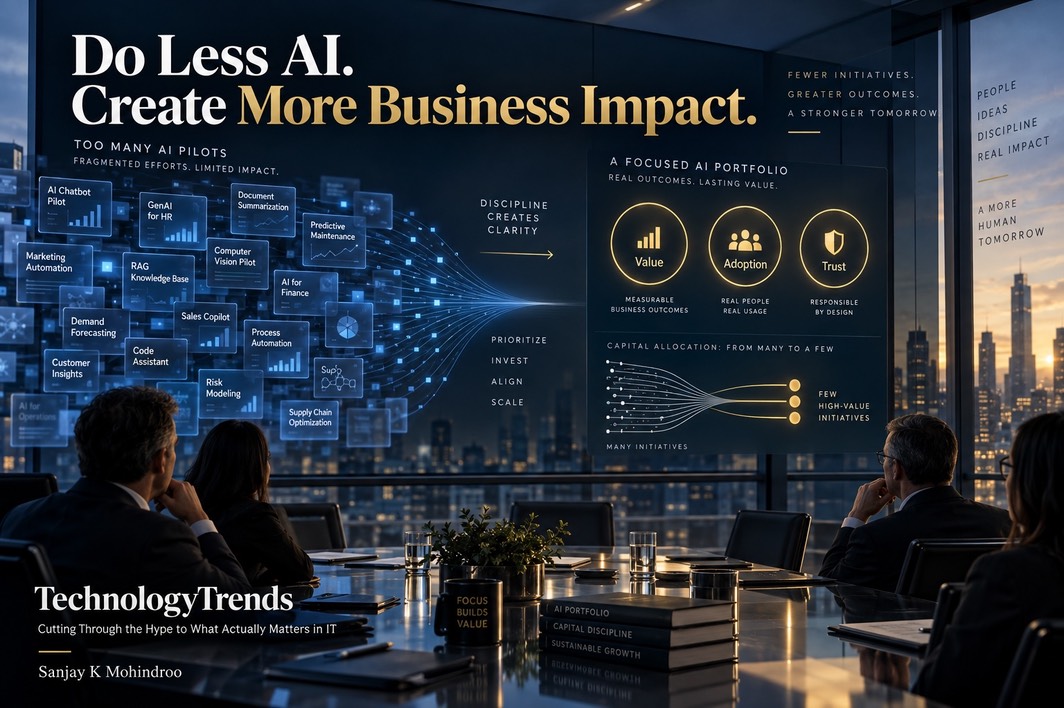
Turning AI Investment into Business Value
Discover how boards can drive real AI impact by measuring business value, adoption, and reliability while aligning cloud, data, and AI strategy.
Over three decades in enterprise technology, I have seen the same pattern repeat.
A programme reaches the board with impressive activity behind it, pilots launched, platforms deployed, dashboards built, vendors mobilized. Then someone asks the question that should have been asked at the beginning: what business value did this actually create?
AI has made that problem more visible.
Most organizations are not short of AI activity. They are short of AI impact.
The conventional wisdom says the winners will be the companies that move fastest, launch the most use cases, and put AI into everything. I think that is the wrong test.
The next phase of AI maturity will belong to organizations willing to do
Do less AI, better.
AI Adoption Is Not AI Value
An organization can have dozens of proofs of concept, multiple copilots, a growing cloud bill and a sophisticated innovation narrative while its core decisions, customer outcomes, operating costs and risk profile remain largely unchanged.
That is not transformation. It is activity.
I have seen versions of this pattern throughout technology cycles. A new platform arrives, adoption becomes the goal, implementation becomes the milestone, and the original business problem becomes less visible as the programme gathers momentum.
AI makes the consequences more expensive because experimentation can spread quickly.
A pilot can work technically and still be a business failure.
Why? Because technical feasibility is not the same as operational readiness.
The model may work, but no business leader owns the outcome. The data may be good enough for a demo, but not reliable enough for daily use. Security, compliance, or risk teams may arrive late. The output may sit in a dashboard that nobody uses to make a decision.
Why AI Pilots Get Stuck
When AI initiatives fail to scale, the technology is often blamed first.
In practice, the harder constraints are usually organizational.
Who owns the outcome?
Who decides whether the pilot scales or stops?
Is the data dependable?
Is the AI output integrated into an actual workflow?
Were risk and compliance involved early enough to shape the solution, rather than block it at the end?
These are operating-model questions.
Many organizations also migrated workloads to the cloud expecting lower cost and greater agility, only to discover higher complexity and disappointing economics. The problem was not necessarily the cloud. Legacy behaviors, unclear ownership, weak cost accountability and old governance models simply moved with the workloads.
Modern infrastructure cannot compensate for outdated operating behavior.
AI will not either.
Cloud, Data and AI Are One Enterprise Capability
Another source of underperformance is organizational separation.
Cloud may sit with infrastructure.
Data may sit with analytics.
AI may sit with an innovation or digital team.
Each can have its own roadmap, budget, governance and leadership forum.
But from a business-value perspective, they are not three separate programmes.
Cloud determines where systems run and how they scale.
Data determines what information is trusted and available.
AI determines how that information is converted into recommendations, decisions or actions.
If those three move independently, scale becomes difficult.
The organization ends up rebuilding pipelines, duplicating controls, creating isolated use cases, and discovering integration problems after the exciting part of the project is complete.
The better model is a single leadership view of cloud, data and AI, with real authority to make trade-offs across speed, cost, risk and business priority.
A decision-making forum, not another committee.
The Three AI Metrics That Matter to the Board
If I were reducing AI oversight to three measures, I would use these.
1. Business Value Realized
Did AI materially improve an outcome the business cares about?
That may mean lower cost, higher revenue, improved productivity, reduced loss, faster turnaround, or lower risk.
Forecast value is not realized value.
A vendor business case is not realized value.
A successful demonstration is not realized value.
The board should ask what measurable change can be attributed to an AI system that is actually operating.
This forces AI investment to compete for capital on the same basis as any other strategic initiative.
2. Adoption in Core Decision-Making
Is the AI being used where work actually happens?
A dashboard that employees ignore is not adoption.
A recommendation engine that managers routinely override without explanation is not adoption.
A copilot with thousands of licenses but little integration into critical workflows may be technologically available and economically irrelevant.
The board should look for evidence that AI is influencing real processes and decisions.
This metric exposes shelfware, weak trust and cosmetic deployment very quickly.
3. Reliability, Risk and Trust
Can the organization depend on the system at scale?
This includes stability, auditability, accountability and the ability to understand how the system behaves over time.
If AI becomes part of a business-critical process, occasional brilliance is not enough.
The system must be dependable.
That means governance cannot be bolted on after the pilot. Risk, security, compliance, and accountability need to be designed into the operating model early.
Good AI governance should increase confidence at speed.
What Would Fail This Board Test?
Apply those three metrics strictly and a surprising amount of AI activity becomes difficult to defend.
Innovation pilots with no accountable business owner would struggle.
Dashboards that generate insights but do not change decisions would struggle.
One-off models built for a single team with custom data and no path to reuse would struggle.
Vendor-led deployments measured by go-live rather than ROI would struggle.
Technically successful projects blocked just before production because governance was considered too late would struggle.
Capital and leadership attention are scarce. AI should not receive an exemption simply because the technology is strategically important.
Fewer AI Initiatives Can Create More AI Value
The obvious counter-argument is that aggressive portfolio pruning could suppress experimentation.
Organizations need room to learn. Some early experiments will not produce immediate returns, and not every useful capability begins with a perfect business case.
But experimentation without discipline quickly becomes innovation theatre.
The answer is not to eliminate pilots.
It is to make their purpose explicit.
Every meaningful pilot should have a business owner, a defined problem, success criteria, production assumptions, and a clear scale, stop, or redesign decision.
A proof of concept should not become a permanent category of investment.
The objective is not fewer ideas. It is fewer orphaned ideas.
When weak initiatives are stopped, funding and leadership attention can move toward the foundations that actually enable scale: better data, reusable platforms, stronger governance, integration, capability building and change management.
Those investments are less exciting than a new demo.
They are also far more valuable.
Real AI Maturity May Look Boring
A mature AI organization may actually become quieter.
Fewer announcements.
Fewer isolated pilots.
Fewer demonstrations created primarily to show momentum.
Instead, AI becomes embedded inside processes.
It shortens decision cycles.
It reduces manual work.
It identifies risk earlier.
It improves consistency.
People stop talking about the tool because they start relying on the capability.
That is what maturity usually looks like in enterprise technology.
The most valuable infrastructure is rarely the infrastructure everyone discusses every day. It becomes dependable, governed, and increasingly invisible.
AI should eventually be no different.
The Board Question Has to Change
Boards still tend to ask familiar technology questions:
How much are we spending?
Are we on schedule?
How many use cases have been launched?
Better questions are:
Who owns the business outcome?
What measurable value has been realized?
Where is AI changing core decisions or workflows?
Which initiatives have explicit scale or stop criteria?
What has been stopped because it failed to deliver?
Can the organization trust the systems that are becoming business-critical?
And are cloud, data and AI investments reinforcing one another or creating three new silos?
These questions change the conversation from technology activity to management accountability.
That is where it belongs.
Do Less AI Better
AI is not failing because the models are not impressive enough.
Cloud is not underperforming because the infrastructure is not modern enough.
Too often, the technology exposes weaknesses that were already present: unclear ownership, fragmented decision rights, poor data discipline, weak governance, and a reluctance to stop initiatives that no longer justify themselves.
The solution is not another wave of pilots.
It is focus.
Align cloud, data and AI.
Pick fewer problems worth solving.
Assign accountable business owners.
Production design, not presentation.
Measure value, adoption and reliability.
Stop what does not survive that test.
A year in which an organization talks less about AI but becomes demonstrably better at decision-making, efficiency and risk control should not be seen as a pause in transformation.
It may be the most important phase of it.
If your board received only three AI metrics next quarter- business value, adoption, and reliability- which initiatives would still deserve capital?
Subscribe to TechnologyTrends, or share in the comments where you think organizations are confusing AI activity with AI impact.
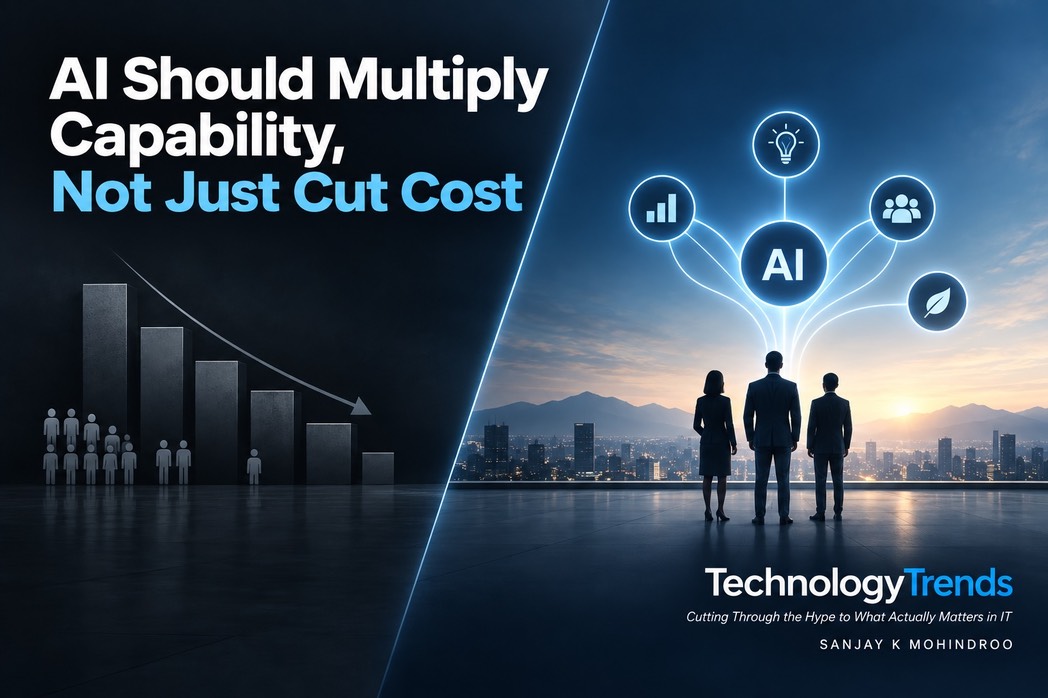
AI ROI: Why Headcount Cuts Miss the Real Value
Sanjay Mohindroo
AI ROI is not just headcount reduction. Learn how boards can measure the capacity, growth, resilience, and capability AI creates across the enterprise.
The AI Cost Paradox.
Why Cutting Headcount Is the Wrong Measure of AI Success
A company invests $100 million in AI and cuts $150 million from annual workforce costs.
On paper, that looks like a triumph. In the boardroom, it may be the beginning of a much more expensive mistake.
The conventional wisdom I want to challenge is simple: if AI can do the work, the quickest way to prove ROI is to remove the people who used to do it.
That logic is financially neat, operationally dangerous, and strategically incomplete.
The real question is not how much work AI can eliminate. It is how much additional economic capacity AI can create, and whether the enterprise can convert that capacity into growth, resilience, better decisions, faster execution, and stronger competitive advantage.
That is the AI cost paradox.
The Easiest AI ROI Is Often the Narrowest
Boards are right to ask where the return is.
AI investment is no longer experimental. Companies are spending heavily on infrastructure, models, cloud capacity, data platforms, applications, talent, and increasingly autonomous agents. At some point, the expenditure has to translate into measurable business value.
The problem is that the easiest value to measure is usually labor cost.
If AI allows a process to be run by six people instead of ten, the arithmetic is immediate. Four salaries disappear. The savings drop into the cost base. The business case becomes visible.
But the balance sheet does not capture what may have disappeared with those four people.
Experienced employees carry accumulated knowledge about customers, products, exceptions, workarounds, supplier behavior, regulatory interpretation, system limitations, and the history behind decisions that make little sense when viewed only through current documentation.
That knowledge is rarely stored cleanly in a database.
So, the board should ask a second question before celebrating the savings: what capability did we remove along with the cost?
AI Creates a Capacity Dividend
This is where the economics of AI need to be reframed.
AI value should not be treated as:
AI value = labor cost eliminated
A better boardroom equation is:
AI value = cost eliminated + cost avoided + productivity capacity created + revenue enabled + quality improvement + risk reduction + innovation value, less AI investment, transformation cost, and AI-related risk.
That is a much harder equation to manage.
It is also much closer to the truth.
Suppose AI releases 500,000 hours of human capacity across an enterprise. Those hours are not worth zero because payroll has not fallen.
They may represent additional customer capacity, shorter product cycles, more sales activity, faster research, stronger risk management, better service, and projects that were previously uneconomic.
I call this the capacity dividend.
The strategic question is not whether the dividend exists. It is what management chooses to do with it.
Redeployment Before Reduction
A board should insist that every significant AI automation program answer five questions in sequence.
1. What work is being eliminated?
Be specific. Reporting, reconciliation, data entry, document processing, routine analysis, customer administration, or some other defined activity.
2. How much capacity is being released?
Do not stop at FTEs. Measure hours, cases, transactions, customer interactions, engineering output, projects, product cycles, or sales capacity.
3. Where can that capacity create more value?
This is the critical step. Can the released capacity be directed into growth, innovation, customer acquisition, product development, operational improvement, or risk management?
4. What skills are required for that move?
This turns AI from a technology program into a workforce transformation program.
5. What capacity remains genuinely surplus?
Only now should structural workforce reduction become the default discussion.
The principle is simple: redeployment before reduction.
This is not an argument against reducing headcount. Some roles will become economically unnecessary. Some activities will disappear. Some organizations will genuinely need fewer people.
The point is sequencing.
Workforce reduction should be an outcome of transformation, not the definition of transformation.
The Biggest Hidden Risk Is Capability Debt
There is another reason boards should be cautious about aggressive AI-led downsizing.
AI is entering knowledge work directly.
Entry-level analysts, researchers, coordinators, administrators, and junior professionals spend much of their time gathering information, building spreadsheets, preparing presentations, performing basic analysis, documenting processes, and responding to routine requests.
AI can increasingly perform a significant share of that work.
The productivity upside is obvious.
The less obvious problem is that these tasks have historically been part of the apprenticeship system through which judgment develops.
If AI does the junior work, where do tomorrow's experienced professionals come from?
The same issue appears in middle management.
A large portion of traditional management consists of collecting information, consolidating reports, tracking performance, coordinating teams, preparing presentations, monitoring projects, communicating priorities, and escalating exceptions.
AI and agentic systems can automate more of that coordination layer.
That may allow organizations to operate with fewer managerial layers, which could be a major advantage.
But if companies remove junior roles and middle-management layers without redesigning how expertise is developed, they may optimize today's cost structure at the expense of tomorrow's operating capability.
That is capability debt.
Like technical debt, it is easy to create and difficult to see until the organization needs the capability it has quietly removed.
AI May Make Expertise More Valuable, Not Less
There is a popular assumption that more capable AI automatically reduces the value of experienced people.
I think the opposite may often be true.
The more powerful the machine becomes, the more valuable the people may become who understand when not to trust it.
Experienced employees know which customers matter disproportionately, which process exceptions are normal, which supplier promises should be discounted, which system documentation is wrong, which regulatory interpretations have practical consequences, and which apparently logical recommendation will fail in the real world.
AI can process enormous volumes of information.
Information is not the same as institutional understanding.
This changes the role of expertise.
The future expert may do less manual analysis and more supervision, exception handling, judgment, orchestration, and decision-making. AI does not necessarily remove expertise. It can increase the leverage of expertise.
For senior leaders, that is a far more interesting economic proposition than replacing skilled people with cheaper automation.
The Incentive Problem Most AI Strategies Ignore
There is also a behavioral issue that receives too little board attention.
Imagine an employee discovers that AI can eliminate 40 percent of their workload.
If the implied corporate message is, "Thank you, your job is now 40 percent redundant," what incentive does that employee have to identify the next automation opportunity?
Very little.
The rational behavior is to protect the work.
That is exactly the opposite of what an AI transformation requires.
Organizations need a different implicit contract: if you automate low-value work, we will help you move toward higher-value work.
Employees should be rewarded for finding automation opportunities, improving processes, adopting AI, increasing productivity, developing new skills, and creating new business value.
That turns the workforce from a target of automation into a participant in transformation.
It also makes adoption far more likely.
The Board Needs a Different AI Scorecard
If headcount reduction is the main measure of AI success, management will naturally optimize toward headcount reduction.
Boards need a broader scorecard.
I would group it into five categories.
First, financial value: AI investment, run-rate savings, avoided hiring, revenue enabled, margin improvement, and payback period.
Second, productivity: output per employee, cycle time, throughput, hours released, customer capacity, and engineering capacity.
Third, capability: AI proficiency, critical-skill coverage, internal mobility, expert retention, knowledge capture, and succession depth.
Fourth, transformation: processes redesigned, agent autonomy, new products, new services, and new revenue streams.
Fifth, risk: AI incidents, model failures, compliance issues, human override, AI-off resilience, and concentration risk.
This gives the board a more complete view of whether AI is making the enterprise cheaper, more capable, or both.
Those are not the same thing.
The New Executive Equation
A useful way to think about the quality of AI transformation is:
AI Autonomy × Business Value × Human Capability Retention
If autonomy increases but business value does not, the organization has created technological complexity.
If business value rises but human capability collapses, the organization may be consuming its future.
If human capability is preserved but AI adoption remains weak, the organization risks protecting yesterday's operating model.
The goal is the intersection.
This is why the strongest AI strategy is not simply a technology strategy.
It is a capital allocation strategy, an operating model strategy, and a workforce strategy at the same time.
The Counter-Argument.
Surely Some Companies Simply Need Fewer People?
Yes.
Any serious discussion of AI has to acknowledge that some work will disappear and some organizations will require fewer employees.
AI will reduce repetitive administrative work. Some coordination layers will become thinner. Some knowledge-work roles will be redesigned beyond recognition.
There is no strategic virtue in preserving work that no longer creates value.
But that is not the same as assuming that the first visible productivity gain should be converted into layoffs.
The better sequence is:
Automate. Measure. Redeploy. Upskill. Transform. Grow. Then ask what capacity is genuinely surplus.
This sequence forces management to test whether released capacity can produce a higher return somewhere else in the enterprise before treating it as waste.
That is simply disciplined capital allocation.
The Real Competitive Advantage Is Organizational Multiplication
The next phase of AI will separate companies into two broad models.
The first will use AI primarily as labor substitution.
They will automate work, remove roles, reduce cost, and improve short-term operating efficiency.
That can be a valid model.
The second will use AI as capability multiplication.
They will automate low-value work, release human capacity, redeploy people toward higher-value activity, redesign roles, increase productivity, and make new products, services, or markets economically viable.
They may still end up with fewer people.
But the reduction will be a consequence of a more capable operating model, not the objective itself.
That distinction matters because the most powerful enterprise may not be the one with the smallest workforce.
It may be the one where every person has dramatically more capability because of the intelligence working alongside them.
The Board Question That Matters
Perhaps the most useful question a board can ask is this:
If AI gave us 30 percent more organizational capacity without increasing our workforce, what would we do with it?
If the answer is, "reduce the workforce by 30 percent," then AI is being treated primarily as a cost program.
If the answer is, "serve more customers, develop new products, improve quality, accelerate innovation, strengthen resilience, enter new markets, and raise the productivity of our people," then AI is being treated as a transformation platform.
That is the choice.
AI will eliminate work. Some jobs will disappear. Some layers will thin. Some traditional career paths will change permanently.
But eliminating work is not the same as eliminating value.
The people inside an enterprise are not just a cost line. They are accumulated capability.
The objective of AI should not be to make the organization smaller.
It should be to make the organization more capable.
What is your board measuring today: headcount removed, or capability created?
If this is a debate happening inside your organization, subscribe to TechnologyTrends or add your perspective in the comments.
Data Intelligence and the Customization of LLMs.
Sanjay Mohindroo
The New AI Frontier
Explore how data intelligence and customized large language models (LLMs) are transforming industries with GenAI and RAG technology.
The Urgency Behind Data Intelligence in LLMs
Organizations worldwide are recognizing that traditional AI tools aren’t meeting specialized needs. Generative AI (GenAI) models and data intelligence tools are becoming pivotal in overcoming limitations and fostering a competitive race to transform how companies leverage data. #DataIntelligence #GenerativeAI #LLM
Generative AI: Sparking a Transformation
With GenAI tools, organizations experience unprecedented gains in creativity and efficiency. Leveraging generative models like OpenAI’s GPT, companies can automate insights, improve customer service, and optimize decision-making with NLP-driven applications. #AITransformation #Innovation
The Race to Custom LLMs: Why It Matters
LLMs (Large Language Models) can understand and generate human-like text. But their true potential lies in customization. By fine-tuning models on specific organizational data, companies can address niche needs while minimizing errors or “hallucinations” in responses. #CustomizedLLMs #DataDriven
RAG: Empowering LLM Customization with Accuracy
Retrieval Augmented Generation (RAG) allows organizations to tailor LLMs with proprietary data to meet specific demands without extensive retraining. RAG retrieves relevant data to make model responses more accurate, reducing costs and improving precision. #RAG #ModelAccuracy
Vector Databases: A Key to RAG’s Success
Vector databases enable RAG by storing and retrieving data based on semantic similarity. These databases facilitate rapid information access, enabling companies to refine model accuracy while decreasing latency. #VectorDatabases #RAGApplications #DataStorage
Open Source LLMs: Embracing Flexibility and Cost Efficiency
Open-source models like Meta’s LLaMA provide customizable frameworks that allow companies to tailor applications for unique challenges. This flexibility empowers even regulated industries like finance and healthcare to adopt GenAI within compliance frameworks. #OpenSource #AIForIndustries
LLM customization and data intelligence are reshaping industries with precision and flexibility. Businesses that embrace these tools will be the true game-changers. #AI #DataIntelligence #FutureOfAI #TechInnovation
Accelerating LLM Deployment: The Power of Unified Platforms
To manage LLMs effectively, organizations need unified data intelligence platforms that streamline the entire data and AI lifecycle—from data ingestion to deployment. By integrating tools like Databricks Unity Catalog, companies can ensure data security, quality, and governance at every stage, accelerating model deployment without sacrificing compliance. #DataPlatforms #UnifiedGovernance #LLMDeployment
The Role of NLP in Revolutionizing Data Science Applications
Natural Language Processing (NLP) is rapidly becoming the backbone of AI-driven solutions, with healthcare, finance, and retail leading in adoption. NLP enables organizations to extract insights from unstructured data, transforming customer feedback, clinical data, and transactional data into actionable insights that support better decisions and improved service delivery. #NLP #DataScience #CustomerInsights
Industry Highlights: Why Regulated Sectors Lead GenAI Adoption
Surprisingly, regulated industries like Financial Services and Healthcare have become early adopters of GenAI, owing to the technology's potential to streamline compliance and security protocols. By leveraging GenAI, these sectors are enhancing fraud detection, patient care, and operational efficiency—all while adhering to strict data governance. #GenAI #RegulatedIndustries #AICompliance
Customizing LLMs with RAG: A Real-World Advantage
In practice, retrieval-augmented generation (RAG) applications are transforming how businesses retrieve and use data. For example, in the financial sector, LLMs powered by RAG are already enhancing fraud detection by accessing up-to-date transaction patterns, while healthcare providers use RAG-enhanced models to quickly interpret complex patient data. #RAGinAction #LLMApplications #IndustrySolutions
The Future of Data Intelligence: Trends to Watch
Looking forward, organizations are expected to adopt even smaller, more efficient LLMs that balance cost, speed, and accuracy. Combined with innovations in data intelligence, this shift is set to make AI-powered insights accessible for businesses of every size. Open-source options will continue to dominate, ensuring customization remains at the forefront of data intelligence. #FutureOfAI #DataTrends #AIAccessibility
The Path to Industry-Wide AI Customization
The customization race for LLMs is driving a transformative wave across sectors, helping companies realize the full potential of their proprietary data. As data intelligence platforms become more sophisticated and accessible, businesses that invest in personalized LLMs will now shape the future of their industries and emerge as leaders in innovation.
The Path to Competitive Advantage with Customized LLMs
The companies harnessing customized LLMs are witnessing more than just operational improvements—they’re establishing a competitive edge. By tailoring LLMs to specific tasks, businesses can achieve faster, more reliable, and contextually accurate insights. This provides a substantial advantage, allowing organizations to predict market trends, understand customer needs, and streamline internal processes more effectively than ever before. #CompetitiveAdvantage #TailoredLLMs #AIInsights
Real-Time Data, Real-Time Results: The Impact of Serverless Architectures
The adoption of serverless architectures is revolutionizing how companies handle data at scale, especially with LLMs. With the flexibility of serverless, organizations can manage and deploy LLMs dynamically, reducing costs and scaling operations instantly to meet demand. This efficiency is particularly valuable in sectors like finance and healthcare, where real-time data is critical for risk assessment, compliance, and decision-making. #Serverless #DataAtScale #RealTimeAI
Building Trust: Unified Governance for Data and AI
As AI becomes central to decision-making, robust data governance frameworks are essential for maintaining security, compliance, and transparency. Platforms like Databricks Unity Catalog allow organizations to manage all AI assets under a single, secure governance umbrella, which is especially critical in highly regulated industries. By implementing unified governance, companies can gain the trust of stakeholders and customers alike. #DataGovernance #SecureAI #TrustInAI
Transforming Industries with Open Source and Proprietary Blend
In balancing open-source and proprietary LLMs, companies find a powerful synergy: the adaptability and transparency of open-source models coupled with the precision and exclusivity of proprietary tools. This hybrid approach lets organizations tailor solutions while controlling costs, making it feasible to deploy AI across diverse business functions without heavy investments. #HybridAI #OpenSourceAdvantage #AIInnovation
From Experimentation to Execution: Efficiency Gains in Production
As data intelligence platforms make it easier to experiment with and deploy AI, the time from testing to production is shrinking rapidly. This shift not only saves costs but also aligns AI innovations with business objectives in real-time. Industries from retail to automotive are deploying LLMs at a pace previously unheard of, leveraging AI-driven insights to optimize everything from supply chain logistics to customer experience. #AIDeployment #EfficiencyInAI #InnovationInAction
The journey to mastering data intelligence and customized LLMs is no longer a distant goal; it’s a practical, achievable path to transforming business. As companies enhance their data capabilities, they’re building the foundations for tomorrow’s industry leaders. With the right balance of technology, governance, and customization, the future of AI is promising and within reach.
Closing Insights: Seizing the Future with Custom Data Intelligence
The AI landscape is evolving fast, and those investing in custom LLMs and data intelligence today are setting the stage for a powerful competitive advantage tomorrow. As these technologies mature, they will drive new business models, enhance user experiences, and open doors to unprecedented levels of efficiency and innovation. The time to act is now, as companies that embrace data intelligence and customization today will shape the future of the industry, drive customer loyalty, and remain agile in a fast-changing market. With the rise of generative AI, RAG, and unified governance frameworks, there’s never been a more thrilling time to explore what’s possible in the world of AI.
The Future is Bright for Innovators
With data intelligence tools becoming more accessible and adaptable, businesses of all sizes can tap into the transformative power of AI. By staying proactive in AI adoption, these organizations are not only advancing their industries but redefining what's achievable in the digital age. #FutureOfWork #AILeaders #InnovationForAll
Call to Action for Industry Leaders
If you’re aiming to future-proof your business, now is the time to invest in tailored AI solutions and data governance. Start with small, high-impact customizations and scale up as you build confidence in these technologies. Remember, the race to customize LLMs is on, and those who prioritize data intelligence today will lead their markets tomorrow.
Implementing Data Intelligence: Key Steps for Success
For organizations looking to start or enhance their journey with data intelligence and customized LLMs, here are some actionable steps to take:
1. Evaluate Your Data Ecosystem
Assess existing data infrastructure and identify gaps where AI can add value. Determine which areas—customer insights, operational efficiency, or risk management—will benefit most from LLM customization. This assessment will clarify the roadmap for successful AI integration. #DataAssessment #AIMapping #LLMPlanning
2. Start with Pilot Projects
Select a high-impact, low-risk area to experiment with LLM customization. Starting with a pilot project allows your team to gather insights, fine-tune models, and refine processes before scaling AI across the organization. Successful pilots can demonstrate the tangible benefits of custom AI to stakeholders. #AIPilots #QuickWins #StakeholderEngagement
3. Leverage RAG and Vector Databases for Enhanced Accuracy
When accuracy is critical, use Retrieval Augmented Generation (RAG) alongside vector databases to customize models with your proprietary data. This combination not only improves output accuracy but also ensures models respond in a way that aligns with your unique data environment. #EnhancedAI #DataPrecision #RAGandVectorDBs
4. Implement Unified Data Governance
Establish a governance framework for your AI initiatives to manage data security, access, and compliance. Unified data governance tools ensure that LLMs are operating within a secure, compliant environment, giving stakeholders confidence in AI’s role in the organization. #DataGovernance #AICompliance #SecureAI
5. Invest in Open-Source and Proprietary Balance
Utilize open-source models for flexibility while integrating proprietary tools for critical applications. This balanced approach enables organizations to innovate rapidly without extensive costs, achieving a tailored solution without over-reliance on vendor constraints. #OpenSourceAI #ProprietaryTools #BalancedAI
6. Monitor, Measure, and Scale
Track key metrics like model accuracy, response relevance, and cost savings. Use these metrics to iteratively improve AI capabilities and scale successful models to other departments or functions. Scaling AI effectively is key to unlocking enterprise-wide transformation. #AIOptimization #ScalableAI #DataMetrics
Shape Your AI Journey Now. Embracing data intelligence and customized LLMs is a journey that pays dividends at every stage. Organizations willing to invest in the right technology and governance now will lead tomorrow’s intelligent industries. Your data holds untapped potential—turn it into your competitive advantage.
With a roadmap in hand, businesses can harness data intelligence and custom LLMs to drive impactful transformation across their operations. #FutureReady #DataStrategy #AIForGrowth
The Lasting Impact: Why Data Intelligence is the New Gold Standard
In today’s data-driven world, data intelligence isn’t just an advantage; it’s the new gold standard for competitive success. Organizations that integrate data intelligence into their operations are not only achieving unprecedented efficiencies but are also driving sustainable growth through innovation. Data-informed decisions, made possible through customized LLMs, are fostering agility in a rapidly evolving market landscape.
Key Takeaways: Making the Most of Data Intelligence
Customization Is Key: Off-the-shelf AI models are powerful, but customization amplifies relevance and accuracy, especially for specialized industry needs.
Data Governance Is Essential: For AI to be trusted and adopted organization-wide, it must operate within a framework that assures data security and regulatory compliance.
Real-Time Responsiveness: Adopting serverless architecture and vector databases equips organizations to make faster, more accurate decisions, particularly in sectors where real-time data is critical.
Balanced Investments in AI: Combining open-source and proprietary models lets organizations tailor their AI strategy to specific business needs without high costs.
The Journey Ahead: Future-Ready with Data Intelligence
The customization of LLMs and the integration of data intelligence platforms mark just the beginning of a new era in AI-driven transformation. As more organizations adopt these technologies, we can expect to see more groundbreaking applications across industries. From personalized healthcare solutions to predictive analytics in finance, the possibilities are limitless. Forward-thinking companies that invest today in data intelligence and customized AI are positioning themselves as tomorrow’s leaders in innovation, agility, and customer satisfaction.
Data intelligence and LLM customization aren’t just trends—they’re catalysts for long-term success and innovation. Embrace these tools to unlock your business’s true potential. #DataDrivenFuture #AIGrowth #InnovationLeaders #LLMCustomization #DataIntelligence
Why the Time to Invest in Data Intelligence is Now
Data intelligence and customized LLMs are no longer optional—they are essential to keeping pace in a world where data-driven insights shape competitive landscapes. The companies that move first to adopt and refine these tools will define best practices, set industry benchmarks, and capture greater market share. By combining strategic customization, rigorous governance, and advanced data platforms, these businesses will empower their teams, optimize processes, and elevate customer experiences.
Embrace the Future: A Call to Innovators
The journey to building a future-ready, data-empowered organization is underway, and the steps you take today will determine your place in tomorrow’s economy. Leaders across industries have the opportunity to drive impactful change and make their mark through intelligent data use and AI customization. The power is in your hands—invest in data intelligence to build a foundation that supports innovation, resilience, and sustainable growth.
Data intelligence is the key to future-proofing your organization. Dive into the customization of LLMs and unleash the full potential of your data. #FutureReady #DataIntelligence #LLMs #AIFuture #IndustryTransformation
Can Ancient Wisdom Help Us Live With AI?

Sanjay Mohindroo
AI is forcing humanity to reconsider consciousness, responsibility, purpose, and human agency. What can ancient philosophical traditions teach us about living with intelligent machines?
Artificial intelligence is one of the most consequential technologies humanity has ever created.
Yet much of the conversation around AI remains remarkably technical.
How intelligent will machines become?
How quickly will AI agents improve?
Which jobs will disappear?
How much productivity can we gain?
How do we make AI safer?
These are important questions. But they may not be the most important ones.
There is another set of questions that predates computers, algorithms, and even modern science:
What does it mean to be human?
What is consciousness?
What is knowledge?
What makes an action right or wrong?
What responsibilities come with power?
What should humans choose not to do, even when they can?
And perhaps most importantly:
What kind of society do we want to build?
These questions have occupied philosophers, theologians, scholars, and thinkers for thousands of years.
AI has simply given them a new urgency.
AI Is More Than a Technology Question
We often approach technological problems with technological solutions.
If AI makes mistakes, improve the model.
If AI produces bias, improve the training data.
If AI creates security risks, build better controls.
If AI takes jobs, redesign the workforce.
All of these responses have value.
But there is a deeper layer.
Suppose an AI system can perform a task better, faster, and more cheaply than a human.
Does that automatically mean we should automate it?
Not necessarily.
There is a difference between capability and wisdom.
Technology answers the question:
Can we do this?
Philosophy asks:
Should we do this?
And civilization depends on the second question as much as the first.
Why Look Backward?
Ancient philosophical traditions were developed long before artificial intelligence, but many of them spent extraordinary amounts of time examining questions that AI is now forcing us to confront.
Indian philosophical traditions, for example, explored consciousness, selfhood, perception, knowledge, action, consequence, duty, and liberation.
Buddhist traditions developed sophisticated thinking around perception, suffering, attachment, and the constructed nature of the self.
Greek philosophy examined reason, knowledge, virtue, ethics, and the good life.
Christian, Jewish, and Islamic traditions developed extensive bodies of thought around human dignity, moral responsibility, knowledge, stewardship, law, and the relationship between human beings and the divine.
Jain philosophy placed extraordinary emphasis on non-harm and intellectual pluralism.
Confucian thought explored relationships, social responsibility, duty, order, and human flourishing.
These traditions are profoundly different.
They should not be collapsed into one generic concept called "ancient wisdom."
But they share something important.
They took seriously the question of how human beings should live.
That is precisely the question AI is beginning to complicate.
What Indian Philosophy Can Contribute
Consider several ideas from Indian philosophical traditions.
Dharma: Capability Does Not Eliminate Responsibility
Dharma is a complex concept with different meanings across Indian traditions and contexts, but broadly includes ideas of duty, conduct, responsibility, and living appropriately within a moral and social order.
Applied cautiously to AI, it raises an important question:
If a machine performs an action, who remains responsible for the consequences?
An autonomous agent may research.
Another may analyze.
Another may recommend.
Another may execute.
But distributing execution across machines does not necessarily distribute accountability.
Someone still owns the outcome.
The more autonomous our systems become, the more important human responsibility becomes.
Karma: Look Beyond the Immediate Result
Karma is often reduced in popular culture to "what goes around comes around."
The philosophical concept is considerably richer.
One useful way to bring the idea into an AI discussion is to focus on action and consequence.
An AI deployment may produce an immediate benefit.
It may reduce costs.
Increase speed.
Improve efficiency.
But what happens next?
Does it weaken human expertise?
Create organizational dependency?
Remove opportunities for people to develop judgment?
Concentrate decision-making power?
Create second- or third-order risks that were invisible in the original business case?
AI strategy therefore needs something more than an ROI calculation.
It needs consequence thinking.
Ahimsa: What Should We Protect?
Ahimsa is commonly associated with non-harm.
In an AI context, that idea can be extended beyond physical harm.
What about cognitive harm?
What happens if people gradually stop exercising skills because machines always perform them?
What happens when people stop remembering because search is always available?
What happens when writing, reasoning, navigation, research, and decision-making become increasingly outsourced?
The question becomes:
What human capabilities should we deliberately preserve even when AI can perform them for us?
That is a very different question from simply asking what AI can automate.
Aparigraha: Just Because We Can Automate It...
Aparigraha is often associated with non-possessiveness and restraint.
It offers another useful thought experiment.
Technology companies and organizations naturally pursue capability.
More automation.
More intelligence.
More autonomy.
More scale.
But perhaps the objective should not always be maximum automation.
It might instead be optimal augmentation.
Just because something can be automated does not mean it should be.
Sometimes keeping a human deliberately in the loop is not inefficiency.
It is resilience.
It is accountability.
It is institutional memory.
It is judgment.
Viveka: The Importance of Discernment
Perhaps one of the most important ideas for the AI age is discernment.
AI can produce an answer that sounds authoritative without necessarily being correct.
It can generate convincing images, persuasive arguments, realistic voices, fabricated evidence, and plausible explanations.
The challenge is no longer simply finding information.
It is determining what deserves to be believed.
AI therefore increases the value of human judgment rather than eliminating it.
The more synthetic information we encounter, the more important discernment becomes.
But Is Hindu Philosophy "More Advanced"?
This is where intellectual discipline matters.
The existence of sophisticated ideas within Indian philosophy does not demonstrate that Hinduism is inherently more advanced than Christianity, Buddhism, Judaism, Islam, Jainism, Greek philosophy, Chinese philosophy, or other intellectual traditions.
Nor does the existence of ancient Indian achievements in mathematics, astronomy, linguistics, medicine, or philosophy prove claims that ancient India possessed modern technologies such as computers, aircraft, nuclear weapons, or artificial intelligence.
Those claims require evidence.
There is no need to make them.
The more interesting proposition is much more defensible:
Different civilizations developed sophisticated ways of thinking about questions that AI is now making unavoidable.
And perhaps we should listen to all of them.
Intelligence Is Not the Same as Consciousness
There is another question where ancient philosophy becomes particularly interesting.
AI systems can increasingly demonstrate sophisticated forms of reasoning, language generation, planning, and problem-solving.
But does intelligence mean consciousness?
Not necessarily.
An AI can manipulate symbols, generate language, recognize patterns, and perform complex tasks without that establishing that it has subjective experience.
Indian philosophical traditions, particularly Vedanta, contain extensive debates about consciousness and the nature of the self.
These traditions do not provide a scientific answer to whether an AI system is conscious.
But they provide something equally valuable for this conversation:
a reminder that intelligence, selfhood, awareness, and consciousness are not necessarily the same thing.
That distinction could become increasingly important as machines become more capable.
The Bigger Question
Perhaps we are approaching AI from the wrong direction.
Instead of asking only:
How do we make AI more intelligent?
We should also ask:
How do we make humans wiser about intelligence?
Instead of asking:
How much work can machines perform?
Ask:
What human capabilities should remain active and meaningful?
Instead of asking:
How autonomous can AI become?
Ask:
Where should humans retain responsibility and judgment?
And instead of asking only:
How do we control AI?
Ask:
What kind of relationship should humans have with increasingly capable machines?
That is a much larger conversation.
And it cannot belong exclusively to technologists.
It belongs to philosophers, scientists, policymakers, educators, business leaders, religious thinkers, artists, psychologists, and ordinary people.
Because AI is not merely changing what machines can do.
It is forcing humanity to reconsider what humans are for.
Perhaps the greatest contribution ancient philosophy can make to the AI age is not teaching machines how to think.
It is reminding humans to think about what thinking is for.
And that raises an even bigger question:
What could we learn if we placed the world's great philosophical traditions into conversation with each other about the future of AI?
That is where the next conversation begins.
What do you think?
Should the AI conversation be primarily a technological one, or do we need a much broader philosophical conversation about what it means to be human in an age of intelligent machines?
#ArtificialIntelligence #AI #AIethics #HumanAI #Technology #FutureOfWork #Philosophy #AIgovernance