
Cataloguing Strategic Innovations
Is AI Really a Revolution, or Just Old Wine in a New Bottle?

Sanjay Mohindroo
Is AI a true revolution or decades-old innovation reaching scale? A CIO perspective on technology evolution, business strategy, and leadership.
For years, I have heard a familiar phrase repeated whenever a new technology trend emerges:
"It's just old wine in a new bottle."
The statement often surfaces when discussing cloud computing, digital transformation, cybersecurity, data analytics, and now, artificial intelligence.
At first glance, the argument seems reasonable.
After all, businesses have been processing information for decades. We have been automating workflows since the days of mainframes. Machine learning research has existed for generations. Neural networks are not new. AI itself was formally discussed in the 1950s.
So if the foundations remain the same, are we simply relabeling old concepts and packaging them differently for each new generation?
Or is something more significant happening beneath the surface?
As someone who has spent years evaluating technology investments, leading digital transformation initiatives, modernizing operating models, and navigating multiple technology cycles, I believe the answer sits somewhere between these two extremes.
The discussion matters because how leaders answer this question shapes investment priorities, technology strategy, talent development, and long-term competitive positioning.
And in many boardrooms today, the wrong answer is driving the wrong decisions.
The Pattern Technology Leaders Keep Missing
Technology’s history follows a surprisingly predictable pattern.
Every decade introduces a breakthrough.
Mainframes.
Client-server computing.
The internet.
Virtualization.
Cloud.
Mobile.
Big Data.
AI.
Each wave arrives with bold claims about changing everything.
Yet when we look beneath the surface, the fundamental objectives rarely change.
Organizations still want to:
- Reduce cost
- Improve productivity
- Increase speed
- Improve decision quality
- Enhance customer experience
- Create a competitive advantage
The business goals remain remarkably consistent.
What changes is the mechanism through which those goals become achievable.
Mainframes centralized computing.
Client-server distributed computing.
The internet-connected businesses globally.
Cloud transformed the economics of infrastructure.
Mobile extended digital access to every employee and customer.
AI is extending automation into areas previously considered uniquely human.
The wine remains familiar.
The bottle keeps changing.
The mistake many organizations make is assuming that because the objective is familiar, the impact must also be familiar.
History suggests otherwise.
Why This Is a Boardroom Issue
This conversation extends far beyond technology.
It influences capital allocation, workforce planning, operating models, risk management, and growth strategy.
Every major technology shift creates winners and losers.
The difference is rarely determined by who adopts first.
It is determined by who understands what is fundamentally changing.
Consider cloud computing.
Many organizations initially viewed the cloud as a cheaper data center.
Those who saw only infrastructure savings captured limited value.
Those who recognized cloud as an operating model transformation changed how they built applications, delivered products, and scaled innovation.
The same pattern is emerging with AI.
Many organizations are treating AI as another software tool.
Others are beginning to rethink knowledge work itself.
The outcomes will likely be very different.
This is why discussions around Digital Transformation Leadership, CIO Priorities, and Emerging Technology Strategy increasingly belong at the board level rather than solely within IT departments.
The question is no longer:
"What technology should we buy?"
The more important question is:
"What assumptions about our business no longer hold?"
The Myth of Overnight Innovation
One of the biggest misconceptions in the market today is that AI appeared suddenly.
The reality is far less dramatic and far more interesting.
Most of the technologies driving today's AI boom have existed for years or decades.
Neural networks were explored in the mid-20th century.
Machine learning matured through decades of academic research.
Statistical modeling has been part of enterprise analytics for generations.
Data science became mainstream years ago.
What changed was not a single breakthrough.
Multiple forces converged simultaneously.
Processing power increased dramatically.
Massive datasets became available.
Cloud infrastructure provided scalable computing resources.
New model architectures improved performance.
Investment levels expanded beyond anything previously seen.
Most importantly, the economics became viable.
The result was not the birth of AI.
It was the commercialization of AI at scale.
That distinction matters.
Leaders who believe AI appeared overnight often underestimate the discipline required to implement it successfully.
Leaders who understand its long evolution tend to focus on data quality, governance, architecture, workforce readiness, and operational integration.
Those are usually the organizations generating measurable returns.
Where the "Old Wine" Argument Breaks Down
While many technology shifts represent incremental improvements, AI introduces something different.
For decades, technology has primarily automated physical and procedural work.
We automated calculations.
We automated transactions.
We automated workflows.
We automated communication.
The target was execution.
AI expands automation into cognitive activities.
Writing.
Research.
Coding.
Planning.
Analysis.
Decision support.
Knowledge discovery.
This creates an entirely different category of opportunity.
For the first time, organizations can meaningfully augment large portions of knowledge work.
That does not mean AI replaces human expertise.
It means the economics of expertise are changing.
And when the economics change, business models often follow.
This is why comparisons between AI and previous technology trends should be made carefully.
Cloud improved how we consume computing.
AI is beginning to change how work itself is performed.
That distinction may define the next decade.
Three Lessons Technology Leaders Should Consider
1. Technology Rarely Changes the Goal. It Changes the Constraints.
Most executives focus on what technology does.
The better question is what limitations it removes.
Cloud removed infrastructure constraints.
Mobile removed location constraints.
AI is removing knowledge-processing constraints.
When leaders focus on removing constraints rather than technical features, they identify opportunities faster.
2. Productivity Gains Are Usually Overestimated in the Short Term and Underestimated in the Long Term.
Technology markets have a habit of creating unrealistic expectations.
Initial hype often leads to disappointment.
Then adoption quietly accelerates.
The internet followed this pattern.
Cloud followed this pattern.
Mobile followed this pattern.
AI appears to be following the same trajectory.
The organizations generating value today are not chasing headlines.
They are systematically embedding AI into workflows where measurable outcomes exist.
3. Operating Models Matter More Than Technology Selection.
Many executives spend enormous effort debating tools, platforms, and vendors.
Those decisions matter.
Yet execution matters more.
The organizations creating sustained value are redesigning processes, governance models, skills, and performance metrics.
Technology implementation is often the easy part.
Operating model evolution is where value is either created or destroyed.
A Practical Framework for Evaluating Emerging Technologies
When assessing any major technology trend, I encourage leaders to ask five questions:
1. What problem does this solve?
Avoid technology-first thinking.
Start with business outcomes.
2. Which constraint does it remove?
Understanding removed constraints often reveals the true opportunity.
3. How does it alter economics?
Technology adoption accelerates when cost, speed, quality, or scale improves materially.
4. What capabilities become strategic?
Every technology shift creates new competitive advantages.
Identify them early.
5. What assumptions become obsolete?
This may be the most important question of all.
Most disruption occurs when organizations continue operating under assumptions that no longer reflect reality.
A Tale of Two Organizations
Consider two hypothetical enterprises evaluating AI.
The first sees AI primarily as a productivity tool.
They deploy copilots, automate meeting notes, and improve internal efficiency.
They generate incremental gains.
The second views AI as a catalyst for IT Operating Model Evolution.
They redesign workflows.
They modernize knowledge management.
They rethink customer engagement.
They transform decision-making processes.
Both organizations use similar technologies.
One improves efficiency.
The other changes the capability.
The difference is strategic thinking, not technology.
Looking Ahead
Over the next five years, I believe we will hear fewer discussions about AI tools and more discussions about AI-enabled organizations.
The competitive battleground will shift from model selection to execution quality.
From experimentation to operationalization.
From technology adoption to business reinvention.
The organizations that succeed will not be those with the largest AI budgets.
They will be the ones that combine technology, talent, governance, and Data-Driven Decision-Making in IT into a coherent strategy.
Which brings us back to the original question.
Is AI simply old wine in a new bottle?
Partly.
Many foundational concepts have existed for decades.
The mathematics is familiar.
The science has deep roots.
The objectives remain largely unchanged.
Yet there is another side to the story.
Every generation reaches a point where existing ideas become economically viable at a scale previously unimaginable.
When that happens, familiar concepts begin producing unfamiliar outcomes.
That is where we are today.
Perhaps the better question is not whether the wine is old or the bottle is new.
The real question is:
What happens when an old idea suddenly becomes practical enough to change the way the world works?
I would be interested to hear how other technology and business leaders view this.
Do you see AI as an evolutionary step built on decades of progress?
Or do you believe we are witnessing the beginning of a fundamentally different era for business and technology?
#DigitalTransformationLeadership #EmergingTechnologyStrategy #CIOPriorities #ArtificialIntelligence #Leadership #DigitalTransformation #TechnologyStrategy #FutureOfWork #EnterpriseAI #Innovation #BusinessTransformation #DataDrivenDecisionMaking #ITLeadership #DigitalBusiness #OperatingModelTransformation
Old Wine, New Bottle? The Truth About AI, Innovation, and the Evolution of Information Technology.

Sanjay Mohindroo
AI isn't new. So why does it feel revolutionary now? A CIO perspective on technology evolution, AI, and business transformation.
AI Is Not New. The Economics of AI Are.
Is Information Technology Really Just Old Wine in a New Bottle?
One of the most interesting questions I have heard in recent years is this:
Is Information Technology simply old wine in a new bottle?
Every few years, the technology industry seems to reinvent itself.
We move from mainframes to client-server architectures. From on-premise infrastructure to cloud. From virtualization to containers. From analytics to artificial intelligence.
Each wave arrives with bold promises. Every new technology is presented as transformational. Every vendor claims to be changing the future.
Yet when we step back and look at the bigger picture, an important question emerges.
Are we truly discovering new principles of computing, or are we repeatedly finding better ways to apply the same fundamental ideas?
As someone who has spent years evaluating technology investments, leading transformation programs, and helping businesses navigate technology change, I find this question increasingly relevant. It is not just an academic discussion. It has direct implications for business strategy, investment priorities, risk management, and competitive advantage.
The answer may challenge some of the assumptions currently driving boardroom conversations around AI, digital transformation, and emerging technology strategy.
The Foundations of IT Have Been Remarkably Stable
Technology evolves rapidly.
The underlying principles evolve much more slowly.
At its core, Information Technology remains focused on a few fundamental concepts:
Data storage.
Data processing.
Communication.
Automation.
Decision support.
Security.
Whether we are discussing a mainframe from the 1970s, a cloud platform, or a modern AI system, these foundational objectives remain largely unchanged.
The industry often introduces new abstractions, new architectures, and new delivery models. What changes is not necessarily the destination. What changes is the speed, scale, accessibility, and economics of getting there.
Cloud computing did not invent computing.
It changed how computing is consumed.
Virtualization did not invent servers.
It improved resource utilization.
The internet did not invent communication.
It dramatically expanded its reach.
This pattern repeats throughout the history of technology.
That is why the phrase "old wine in a new bottle" carries some truth.
The bottle changes frequently.
The wine changes much less often.
Why This Matters in the Boardroom
Many leaders focus heavily on technology features.
The more important discussion revolves around business outcomes.
Boards do not invest in technology because it is interesting.
They invest because it creates growth, efficiency, resilience, or competitive differentiation.
Understanding whether a technology represents an incremental improvement or a fundamental shift affects how organizations allocate capital, develop talent, manage risk, and design operating models.
This is where Digital Transformation Leadership becomes critical.
Organizations that mistake incremental change for disruption often overspend.
Organizations that dismiss genuine disruption as another passing trend often fall behind.
The challenge for today's leadership teams is determining which category AI belongs to.
Is it simply another technology cycle?
Or is it something fundamentally different?
Fact Check: Did AI Suddenly Appear?
The short answer is no.
AI is not new.
In fact, many of the concepts powering today's AI systems have existed for decades.
Neural networks were first proposed in the 1940s.
Machine learning research accelerated during the 1980s and 1990s.
Speech recognition systems have existed for years.
Recommendation engines have shaped consumer experiences for over a decade.
Fraud detection systems have used machine learning techniques for years.
What many people call the "AI revolution" is actually the result of a long period of gradual progress.
Science has been evolving steadily.
The recent breakthrough was not the appearance of AI.
It was the convergence of multiple factors.
Massive datasets became available.
Cloud platforms provided scalable infrastructure.
Graphics processing units have dramatically increased computational capability.
New model architectures improved performance.
Investment levels reached unprecedented levels.
The result was a dramatic improvement in practical usability.
The difference between AI research and AI adoption is enormous.
We crossed that gap recently.
Where the Hardware Argument Is Correct — and Where It Isn't
I often hear the argument that AI became revolutionary because hardware finally caught up.
There is considerable truth in that statement.
Without modern GPUs, many of today's large language models would be economically impossible to train and operate.
Hardware has been a major enabler.
Yet attributing the entire breakthrough to hardware misses an important point.
A Formula 1 engine is useless without a race car.
Similarly, computational power alone does not create intelligence.
The breakthrough came from the combination of:
· Better algorithms
· Larger datasets
· Advanced hardware
· Cloud-scale infrastructure
· Significant capital investment
· Open research collaboration
Remove any one of these factors, and the current AI landscape looks very different.
The lesson for leaders is important.
Technology breakthroughs rarely emerge from a single innovation.
They emerge when multiple innovations mature simultaneously.
Why AI Feels Different
This is where the discussion becomes particularly interesting.
Most previous technology waves focused on automating processes.
AI is increasingly focused on augmenting cognition.
Traditional IT automated transactions.
AI assists with reasoning.
Traditional IT accelerated workflows.
AI supports knowledge work.
Traditional IT processed information.
AI interprets information.
This distinction matters.
For decades, technology has primarily transformed operational efficiency.
AI has the potential to transform intellectual productivity.
That is a much larger opportunity.
It is also a much larger challenge.
Three Leadership Lessons We Should Not Ignore
1. Technology Does Not Create Value. Adoption Does.
Many organizations remain trapped in pilot mode.
They experiment extensively but operationalize very little.
The winners will not necessarily be those with the best models.
The winners will be those who integrate AI into real business processes.
2. Data Quality Matters More Than Model Sophistication
In many enterprises, data remains fragmented, inconsistent, and poorly governed.
Organizations often focus on AI before addressing foundational data challenges.
That approach rarely scales.
Strong Data-Driven Decision-Making in IT begins with trusted information.
3. Operating Models Will Become the Real Battleground
Technology can often be purchased.
Transformation cannot.
As AI capabilities become increasingly accessible, competitive advantage will shift toward execution, governance, talent development, and IT Operating Model Evolution.
The technology may become a commodity.
The ability to use it effectively will not.
A Practical Framework for Senior Leaders
When evaluating any emerging technology, I recommend asking five simple questions:
1. What business problem does it solve?
2. Which constraints does it remove?
3. How does it change economics?
4. What new risks does it introduce?
5. Which assumptions about our business become outdated?
These questions help separate genuine strategic opportunities from temporary market excitement.
They also help leaders focus on outcomes rather than technology labels.
Looking Ahead
I believe the next decade will not be defined by AI models.
AI-enabled organizations will define it.
The conversation will gradually shift away from model benchmarks, token counts, and technical specifications.
Leadership teams will focus on productivity gains, customer experience improvements, workforce transformation, and business model innovation.
The organizations that succeed will not be those chasing every new trend.
They will be those who understand both continuity and change.
The continuity lies in the enduring principles of computing.
The change lies in what those principles now make possible.
So, is Information Technology old wine in a new bottle?
Partly.
Many of the foundations remain remarkably consistent.
Yet history shows that when familiar ideas become available at a scale and cost that were previously impossible, the impact can be revolutionary.
Perhaps the better question is not whether the wine is old or the bottle is new.
The real question is this:
What happens when decades of innovation suddenly become practical enough to reshape how every business creates value?
That is the conversation technology leaders should be having today.
#DigitalTransformationLeadership #EmergingTechnologyStrategy #CIOPriorities #ArtificialIntelligence #TechnologyLeadership #BusinessTransformation #FutureOfWork
Cost Cutting Is Easy. Value Creation Is Leadership: A Framework Every Executive Should Use.

Sanjay Mohindroo
A Framework Every Executive Should Use.
A practical executive framework to separate cost-cutting from value creation, helping CEOs, CIOs, and boards drive sustainable business outcomes through technology and leadership.
Every organization wants efficiency. Every board asks about costs. Every leadership team seeks growth.
Yet many companies continue to confuse cost reduction with value creation.
The distinction matters.
Cost cutting improves financial performance for a period of time. Value creation strengthens competitive advantage, accelerates growth, improves customer outcomes, and increases enterprise resilience.
After more than three decades leading technology organizations across global enterprises, I have observed a recurring pattern. The most successful companies do not ask, "How much can we save?" They ask, "What value can we unlock?"
This article presents a practical framework that helps leaders separate necessary cost discipline from true value creation and make better investment decisions in technology, operations, and transformation initiatives.
The Leadership Trap
Why Smart Organizations Still Get This Wrong
In difficult economic environments, the pressure to reduce costs becomes intense.
Budgets tighten. Hiring slows. Projects are reviewed. Technology spending comes under scrutiny.
None of this is unusual.
The challenge emerges when cost reduction becomes the primary lens for decision-making.
I have sat in countless executive reviews where teams proudly reported millions in savings. Yet twelve months later, customer experience had deteriorated, innovation had slowed, employee engagement had declined, and growth opportunities had been missed.
The organization spent less.
The business became weaker.
That is not value creation.
That is simply spending less money.
Strong leaders recognize the difference.
#Leadership #BusinessTransformation
The Four-Quadrant Framework
Separating Efficiency from Enterprise Value
Over the years, I have found that every technology and operational initiative can be evaluated through two simple questions:
1. Does it reduce costs?
2. Does it increase business value?
The answers create four distinct categories.
Quadrant One: Cost Reduction Without Value Creation
Examples include indiscriminate budget cuts, across-the-board hiring freezes, or eliminating capabilities without understanding long-term impact.
These actions improve short-term financial metrics but often weaken organizational capability.
This is where many companies spend too much time.
Quadrant Two: Cost Reduction With Value Creation
This is the sweet spot.
Examples include process automation, infrastructure modernization, application rationalization, and intelligent sourcing strategies.
Costs decrease while business performance improves.
Every executive team should actively seek opportunities in this quadrant.
Quadrant Three: Value Creation Without Immediate Cost Reduction
Many strategic investments belong here.
Digital products, advanced analytics, AI-enabled customer experiences, and new revenue platforms may increase spending initially while creating significant future value.
Strong leadership requires the courage to invest when value is clear.
Quadrant Four: Neither Cost Reduction nor Value Creation
These initiatives should be challenged aggressively.
If an investment creates neither efficiency nor strategic advantage, it deserves scrutiny.
The framework sounds simple.
The discipline to apply it consistently is what separates effective leadership from reactive management.
#CIO #Strategy #TechnologyLeadership
Cloud-First Is Not Always Business-First
For years, organizations have embraced cloud migration as a near-universal strategy.
The narrative became simple:
Move to the cloud.
Reduce costs.
Become more agile.
Reality is far more complex.
I have seen organizations spend tens of millions moving workloads into cloud environments only to discover that operating costs increased, governance became more difficult, and expected benefits never materialized.
The problem was never the cloud.
The problem was treating technology decisions as objectives rather than business outcomes.
Technology is not the destination.
Business value is.
Cloud, AI, automation, data platforms, and cybersecurity investments should never be measured by adoption alone.
They should be measured by business impact.
Revenue growth.
Customer satisfaction.
Speed to market.
Risk reduction.
Operational resilience.
When executives focus on outcomes instead of technology trends, decision quality improves dramatically.
The question is not whether a solution is modern.
The question is whether it creates measurable value.
#DigitalTransformation #CloudStrategy
Follow the Value Chain
Technology Matters Most When It Changes Business Outcomes
One exercise I often use with leadership teams is deceptively simple.
For every major investment, continue asking:
"What business outcome does this improve?"
Then ask again.
And again.
Eventually, every initiative should connect to one of five outcomes:
Revenue growth.
Customer experience.
Risk management.
Operational efficiency.
Strategic differentiation.
If the connection cannot be clearly explained, the investment may be solving an internal technology problem rather than a business problem.
That distinction changes conversations.
Boards understand value.
CEOs understand value.
Customers experience value.
Technology exists to enable it.
Nothing more.
Nothing less.
Measuring What Matters
Metrics That Reveal Real Value
Many organizations still evaluate technology success using activity metrics.
Projects delivered.
Servers migrated.
Applications modernized.
Tickets resolved.
These metrics describe effort.
They do not describe value.
The strongest organizations measure outcomes instead.
Revenue impact.
Customer retention.
Productivity gains.
Risk reduction.
Cycle-time improvement.
Employee experience.
Innovation velocity.
When metrics shift from activity to outcomes, leadership attention shifts as well.
The conversation becomes strategic rather than operational.
That is where technology leaders earn influence.
#BusinessValue #ExecutiveLeadership
Questions Every Leadership Team Should Ask
Before approving any major initiative, ask five questions:
Does it reduce costs?
Does it improve customer outcomes?
Does it strengthen competitive advantage?
Does it reduce risk or increase resilience?
Can we clearly measure business value after implementation?
If the answer to all five is unclear, more work is needed before proceeding.
Technology investment should never be an act of faith.
It should be a deliberate business decision supported by evidence, accountability, and measurable outcomes.
The Future Belongs to Value Creators
Cost discipline will always matter.
Responsible stewardship of resources is a leadership obligation.
But organizations do not achieve greatness by cutting their way to success.
They achieve it by creating value consistently, intentionally, and at scale.
The leaders who thrive over the next decade will be those who bring clarity to complexity.
They will connect technology to outcomes.
They will challenge fashionable narratives.
They will invest where value is created and eliminate what no longer serves the business.
Most importantly, they will understand a principle that has remained true throughout my career:
Technology does not create value.
Leadership does.
And leadership determines where technology creates value.
#Leadership #CIO #CEO #BoardLeadership #TechnologyLeadership #DigitalTransformation #BusinessTransformation #BusinessValue #EnterpriseArchitecture #Innovation #ExecutiveLeadership #ITStrategy #FutureOfWork #OperationalExcellence #Strategy #BusinessGrowth #Consulting #TransformationLeadership
Lean IT Is Not About Cost Cutting. It Is About Respecting Time.
Sanjay Mohindroo
Lean IT Is Not About Cost Cutting. It Is About Respecting Time.
A senior IT leader’s perspective on Lean IT, how to remove operational friction, and why efficiency comes from clarity, not cost cutting.
Lean IT is often misunderstood as a cost reduction exercise. That is where most organizations get it wrong.
Lean thinking in IT is about flow, clarity, and disciplined execution. It focuses on removing friction that slows delivery, frustrates teams, and weakens business outcomes.
In my experience across large global organizations, the most effective IT functions are not the biggest or the most funded. They are the ones that move with precision.
This piece explores how Lean thinking applies to IT operations in the real world, where it breaks down, and what leadership must do to make it sustainable. #Leadership #CIO #LeanIT
The hidden cost no one measures
Ask any CIO about cost pressures, and you will get a detailed answer. Infrastructure spend. Vendor contracts. Headcount.
Ask them how much time is wasted across IT operations, and the room goes quiet.
Time is the most under-managed asset in IT.
I have seen teams spend weeks waiting for approvals, chasing dependencies, reworking unclear requirements, and fixing avoidable defects. Not because people lack capability, but because systems lack flow.
Lean IT starts with a simple question.
Where is time being lost, and why?
What Lean Really Means in IT
It is about flow, not frameworks
Lean thinking did not originate in IT. It came from manufacturing, where efficiency is visible and measurable.
In IT, the waste is less visible. It hides in processes, handoffs, and decisions.
Lean IT focuses on flow. Work should move smoothly from idea to delivery without unnecessary delay or rework.
In one organization, we mapped the lifecycle of a simple change request. It took 28 days end to end. The actual work took less than 6 hours.
The rest was waiting.
Approvals, queue delays, unclear ownership.
Once we removed those friction points, delivery time dropped to under a week. No new tools. No additional budget. Just clarity and discipline.
That is Lean IT in practice. #LeanThinking #ITOperations
The Waste We Ignore
Not all inefficiencies look like problems
In IT, waste does not always appear as failure. It often looks like normal operations.
Multiple status meetings that do not change outcomes
Repeated data entry across systems
Over-engineered solutions for simple problems
Long approval chains that add no real value
These are accepted as part of the system. They should not be.
In one transformation, we eliminated over 30 percent of recurring meetings. Not because meetings are bad, but because many existed without purpose.
The result was immediate. More time for actual work. Better focus. Faster decisions.
Lean thinking forces organizations to question what they have normalized.
Efficiency does not come from doing more with less. It comes from doing less of what does not matter
There is a persistent belief that Lean IT is about pushing teams to do more with fewer resources.
That belief is flawed.
Pushing teams harder without addressing system inefficiencies leads to burnout, not performance.
True efficiency comes from removing unnecessary work.
I have seen organizations invest heavily in automation while ignoring process complexity. They automate inefficiency and call it progress.
In one case, a team automated a reporting process that no one actually used for decision-making. It saved hours of effort. It added no value.
Lean IT starts with value. What matters. What does not.
Only then does efficiency follow. #OperationalExcellence
Designing Lean into IT Operations
Build systems that reduce friction
Lean IT must be designed into how work flows, not added as a layer on top.
Start by mapping key workflows. Identify delays, bottlenecks, and rework points.
Simplify wherever possible.
Reduce handoffs. Each handoff introduces delay and risk of misalignment.
Clarify ownership. When everyone is responsible, no one is accountable.
Standardize where it adds value, but avoid rigidity.
In a global rollout I led, we reduced the number of approval layers from six to two for most operational decisions.
The impact was immediate. Faster execution. Better accountability.
Leaders often underestimate how much speed comes from simplicity.
The Role of Leadership
Lean fails without leadership discipline
Lean IT is not a process initiative. It is a leadership discipline.
Leaders set the tone for what is acceptable.
If delays are tolerated, they will multiply.
If complexity is ignored, it will grow.
If clarity is missing, teams will create their own versions.
In organizations where Lean worked, leaders were deeply involved. Not in micromanaging tasks, but in shaping systems.
They asked simple questions repeatedly.
Why does this step exist
Who benefits from it
What happens if we remove it
These questions sound basic. They are not easy to answer.
Because they challenge long-standing habits.
Lean and Technology
Tools do not create flow. Systems do
There is a tendency to look for technology solutions to operational problems.
Workflow tools. Automation platforms. AI-driven optimization.
These are useful. But they are not the starting point.
If the underlying process is unclear or inefficient, technology will amplify the problem.
In one organization, we paused a major automation initiative. Instead, we spent six weeks simplifying workflows.
When automation resumed, it delivered twice the impact with half the complexity.
Lean thinking ensures that technology supports flow, rather than masking inefficiencies.
What Gets in the Way
The quiet barriers to Lean IT
Lean IT sounds simple. It is not easy to sustain.
Common barriers include
Cultural resistance to change
Fear of losing control when processes are simplified
Misaligned incentives across teams
Short-term pressure that overrides long-term discipline
I have seen Lean initiatives start strong and fade within months.
The reason is predictable.
They are treated as projects, not as ways of working.
Lean requires consistency. Small improvements, repeated over time.
What senior leaders should act on
Measure time as a critical asset across IT operations
Identify and eliminate non-value-adding activities
Simplify workflows and reduce handoffs
Align accountability clearly across teams
Use technology to support, not replace, Lean thinking
Embed Lean principles into daily operations, not as a separate initiative
Create leadership focus on flow, not just output
Speed comes from clarity, not pressure
Lean IT is not about cutting costs or reducing headcount.
It is about creating systems where work flows smoothly, decisions are clear, and teams can focus on what matters.
The organizations that succeed are not the ones that push harder.
They are the ones that remove friction.
In a world where speed is critical, clarity becomes the real advantage.
And Lean thinking, applied with discipline, delivers exactly that.
#LeanIT #Leadership #CIO #OperationalExcellence #DigitalTransformation #ITOperations #ProcessImprovement #EnterpriseIT #TechnologyLeadership #BusinessEfficiency
Business–IT Convergence Is Not a Strategy. It Is a Discipline.
Sanjay Mohindroo
A senior IT leader’s perspective on Business–IT convergence, why most efforts fail, and how leadership can make alignment work in real organizations.
Every organization claims alignment between business and IT. Very few achieve it.
Business–IT convergence is not about structure charts, reporting lines, or new roles. It is about how decisions are made, how priorities are set, and how accountability is shared.
In my experience across global enterprises, convergence works when technology is treated as a business capability rather than a support function. It fails when IT is invited late, measured narrowly, or expected to execute without context.
This piece breaks down what real convergence looks like, why most efforts stall, and what leaders must do differently to make it work at scale. #Leadership #CIO #DigitalTransformation
The meeting that says everything
I have seen this pattern too many times.
The business presents a bold growth plan: expansion, new markets, sharper customer experience. The room is energized.
Then someone turns to IT.
“How long will this take?”
At that moment, convergence has already failed.
Because IT was not part of shaping the plan. It was brought in to react to it.
Business–IT convergence is not about faster execution. It is about shared thinking before execution begins.
The Illusion of Alignment
Why most organizations believe they are aligned when they are not
Many organizations confuse communication with alignment.
Weekly meetings. Steering committees. Status updates. These create visibility, not alignment.
Alignment means something deeper. It means both sides understand the same priorities, trade-offs, and outcomes. It means decisions are made with a shared view of value.
In one organization, business leaders pushed for rapid feature releases. IT pushed back, citing system stability. Both were right. Neither was aligned.
We reframed the conversation. Not speed versus stability, but revenue impact versus operational risk.
That changed everything.
The debate shifted from functions to outcomes. That is where convergence begins. #BusinessStrategy #ITLeadership
Technology Is the Business
Stop treating IT as a delivery arm
There is still a quiet assumption in many boardrooms that IT exists to support the business.
That assumption no longer holds.
Technology shapes customer experience, pricing models, supply chains, and even revenue streams. In many industries, it is the business.
When I led large-scale transformations, the most effective shift was simple. We stopped asking, “What does the business need from IT?”
We started asking, “How do we design the business with technology at its core?”
That shift moved IT leaders from the sidelines to the center of strategic conversations.
It also raised the bar. Because once you are at the table, execution matters even more.
Business–IT convergence does not fail because of silos. It fails because of leadership comfort
It is easy to blame silos. They are visible. They are measurable. They are convenient.
But silos are a symptom. Not the cause.
The real issue is leadership comfort.
Business leaders are comfortable defining strategy without technical depth. IT leaders are comfortable focusing on delivery without challenging business assumptions.
Both stay in their lanes. And convergence never happens.
In one global organization, we broke this pattern deliberately. Business leaders were required to present technology implications as part of strategy proposals. IT leaders were expected to challenge commercial assumptions, not just execution plans.
It was uncomfortable at first.
Then it became powerful.
Because convergence is not about breaking silos. It is about expanding leadership thinking. #ExecutiveLeadership
Designing for Convergence
Building structures that force collaboration
Convergence does not happen by intent. It happens by design.
The most effective organizations I have worked with did three things well.
They aligned funding to outcomes, not functions. Budgets were tied to business capabilities, not departments. This forced shared ownership.
They created joint accountability. Success metrics were shared between business and IT leaders. No one could succeed alone.
They embedded cross-functional teams. Not as a temporary initiative, but as a standard operating model.
In one case, we moved from project-based funding to capability-based funding. It reduced internal friction overnight.
Because people stopped negotiating budgets and started solving problems together.
The Execution Gap
Where convergence efforts quietly break down
Even when strategy is aligned, execution often drifts.
Priorities change. Timelines stretch. Trade-offs become unclear.
This is where many convergence efforts lose momentum.
The issue is not intent. It is discipline.
Clear decision frameworks are essential. Who decides. Based on what inputs. Within what timeframe.
Without this, alignment at the top does not translate into action on the ground.
I have seen transformations stall because teams waited for perfect clarity. In reality, progress requires structured ambiguity. Enough clarity to move, enough flexibility to adapt.
That balance is where leadership matters most.
The Role of the CIO
From technology leader to business partner
The CIO role has evolved. The expectations have changed.
It is no longer enough to deliver reliable systems and control costs.
Today, the CIO must shape business strategy, influence outcomes, and drive value creation.
This requires a different mindset.
Speak the language of business, not technology.
Frame conversations around impact, not implementation.
Challenge assumptions when needed.
In my experience, the most respected CIOs are not the most technical. They are the ones who bring clarity to complex decisions.
That is what boards value. #CIO
What Leaders Get Wrong
Common mistakes that slow convergence
There are patterns I see repeatedly across organizations.
Treating convergence as a one-time initiative rather than an ongoing discipline
Measuring IT on efficiency while expecting innovation
Involving IT too late in strategic discussions
Overloading teams with parallel priorities
Avoiding difficult trade-off conversations
Each of these seems manageable in isolation. Together, they create friction that slows everything down.
Convergence requires consistency. Not bursts of activity.
What senior leadership must act on
Bring IT into strategy discussions from day one
Align funding and metrics to business outcomes
Establish shared accountability across functions
Create clear decision frameworks
Simplify priorities and focus execution
Encourage leaders to operate beyond their functional comfort zones
Measure success through business impact, not activity
Convergence is a leadership choice
Business–IT convergence is not about tools, frameworks, or organization charts.
It is about how leaders think, collaborate, and decide.
The organizations that get this right move faster. They adapt better. They compete stronger.
Not because they have better technology.
But because they use it with clarity and purpose.
In the end, convergence is not achieved through initiatives. It is built through everyday decisions.
And that is where real leadership shows.
#BusinessITConvergence #Leadership #CIO #DigitalTransformation #ITStrategy #BusinessStrategy #ExecutiveLeadership #TechnologyLeadership #EnterpriseIT #OrganisationalDesign
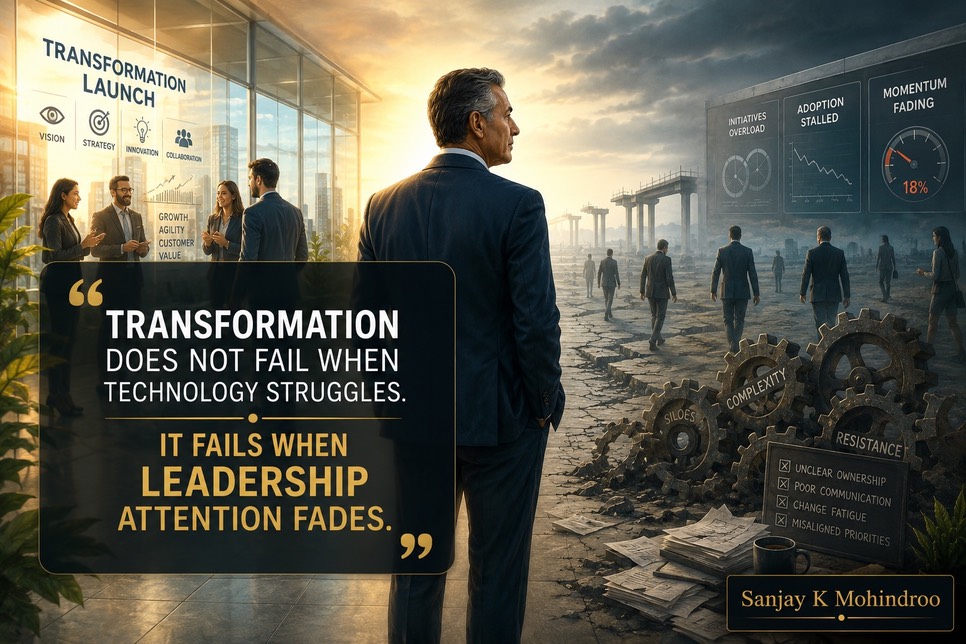
Why Most Transformation Programs Lose Momentum After Year One.
Sanjay Mohindroo
Why most transformation programs lose momentum after year one. A senior IT leader shares hard-earned lessons on leadership, execution discipline, and business alignment.
Most transformation programs do not fail in the beginning. They fail after the applause.
The first year usually looks impressive. New dashboards appear. Steering committees expand. Consultants present ambitious roadmaps. Leadership communicates urgency. Budgets flow.
Then momentum fades.
The reason is rarely technology. It is usually leadership fatigue, unclear business ownership, weak operational integration, and the absence of disciplined execution after the launch phase.
Over three decades leading global IT and business transformation initiatives, I have seen one pattern repeat itself across industries, geographies, and leadership teams: organizations underestimate the emotional and operational endurance required for long-term transformation.
Transformation is not an event. It is a sustained leadership behavior.
That distinction changes everything.
#Leadership #DigitalTransformation #CIO
The Excitement Phase Is Easy
Every organization loves the beginning of transformation
The first twelve months of a transformation program are usually full of energy.
There is visibility. There is executive sponsorship. There are workshops, town halls, design sessions, and strategy decks with ambitious timelines. The organization feels alive. Everyone wants to be associated with the initiative.
This is also the phase where technology vendors thrive.
Cloud migrations begin. AI pilots appear. Automation projects multiply. New platforms enter the ecosystem. The board sees movement. Investors hear the right language.
But activity is not transformation.
I once worked with a multinational organization that launched one of the most ambitious enterprise modernization programs I had seen in years. The first nine months were exceptional. Leadership alignment was strong. Funding was secure. Teams moved quickly.
By month fourteen, priorities shifted.
Quarterly financial pressure increased. Business leaders started protecting local metrics. Talent attrition hit critical delivery teams. Governance meetings became status reviews instead of decision forums.
The transformation did not collapse dramatically. It simply slowed down quietly.
That is how most programs lose momentum. Not through crisis. Through gradual erosion.
Technology Rarely Breaks the Program
Human systems break long before technical systems do
Most organizations still treat transformation as a technology exercise.
It is not.
Technology changes fast. Human behavior does not.
The hardest part of transformation is convincing experienced managers to abandon systems and processes that made them successful for twenty years. That resistance rarely appears openly. It shows up subtly.
Delayed approvals.
Endless requests for “additional validation.”
Parallel spreadsheets outside the official platform.
Meetings that revisit decisions already made.
This is why transformation leadership requires operational credibility, not just technical expertise.
Teams follow leaders who understand business pressure. They trust leaders who understand customer impact, margins, operational risk, and workforce anxiety.
In global programs, I have seen technically brilliant initiatives fail because leadership underestimated cultural friction. A process that works in one region may create political resistance in another. A centralized operating model may improve efficiency while damaging local accountability.
Transformation is deeply human work disguised as technology work.
That truth deserves more attention in boardrooms.
The Contrarian Reality
Digital transformation is not failing. Leadership discipline is.
For years, we have heard the same narrative: “Digital transformation programs fail at alarming rates.”
I disagree with that framing.
Most transformation strategies are directionally correct. The problem is execution endurance.
Organizations love transformation when it feels innovative. They struggle when it becomes operational discipline.
The second year is where reality begins.
That is when leaders must standardize processes. Reduce duplication. Remove legacy exceptions. Enforce accountability. Simplify governance. Measure adoption honestly instead of cosmetically.
That work is less glamorous.
There are no headlines for process simplification.
No executive excitement around retiring legacy workflows.
No standing ovation for cleaning enterprise data structures.
But that is where transformation becomes real.
One CEO told me during a difficult enterprise restructuring, “The organization wanted change. It just did not want inconvenience.”
That sentence captured the entire problem.
Transformation requires sustained executive consistency long after enthusiasm disappears.
Without that consistency, organizations return to old habits with astonishing speed.
#BusinessTransformation #ExecutiveLeadership
Too Many Programs Chase Speed Instead of Stability
Fast launches create fragile foundations
There is enormous pressure today to move quickly.
Boards want measurable outcomes within quarters. Investors expect visible modernization. Leadership teams fear appearing slow compared to competitors.
The result is predictable.
Organizations accelerate implementation while neglecting operating maturity.
I have seen companies deploy advanced analytics platforms without fixing data ownership. I have seen AI initiatives launched inside organizations with deeply fragmented processes. I have seen cloud programs migrate complexity rather than reduce it.
Speed without structural discipline creates expensive instability.
A successful transformation program should feel boring at times.
That may sound strange coming from someone who has spent decades leading large-scale change initiatives, but it is true.
Mature transformation is operationally calm.
Teams understand accountability. Governance becomes routine. Metrics become predictable. Technology stops being the center of attention as business performance takes center stage.
That is the real goal.
Transformation should eventually disappear into the operating model.
The Missing Layer Most Boards Underestimate
Middle management determines whether transformation survives
Senior leadership creates direction.
Frontline teams execute tasks.
Middle management determines whether transformation becomes culture.
This layer is often ignored.
Middle managers absorb the pressure from both sides. They manage operational targets while implementing change initiatives. They are expected to deliver business continuity while adapting new systems, processes, and reporting structures.
If they are exhausted, confused, or unconvinced, transformation slows immediately.
Strong transformation leaders spend significant time with this layer.
Not in ceremonial town halls.
In real operational conversations.
What is slowing adoption?
What incentives are misaligned?
Which processes create unnecessary friction?
Where are teams quietly bypassing the system?
Transformation success depends on operational honesty.
Many organizations still reward optimistic reporting instead of transparent reporting. That creates dangerous blind spots.
Leaders cannot fix what people are afraid to say.
#CIO #ChangeManagement #EnterpriseTransformation
What separates sustained transformation from temporary momentum
1. Treat transformation as an operating discipline, not an innovation campaign.
2. Measure behavioural adoption, not just technical deployment.
3. Keep executive sponsorship active after launch-year excitement fades.
4. Simplify governance relentlessly. Complexity kills momentum.
5. Invest heavily in middle management alignment.
6. Resist the temptation to overload the organization with simultaneous initiatives.
7. Tie transformation outcomes directly to business performance, customer experience, and operational resilience.
8. Communicate consistently. Silence creates organizational drift.
The organizations that succeed are rarely the loudest.
They are usually the most disciplined.
Transformation survives where leadership stays consistent
After thirty years in enterprise technology and business transformation, one lesson stands above the rest.
Transformation is not sustained by strategy decks, technology platforms, or launch events.
It is sustained by leadership behavior repeated consistently over time.
Organizations lose momentum after year one because leadership attention moves elsewhere. Operational discipline weakens. Governance becomes symbolic. Accountability fades. Complexity returns.
Technology cannot solve those problems.
Leadership can.
The companies that will lead the next decade are not necessarily the ones investing the most in technology. They are the ones building the strongest alignment between business strategy, operational execution, and human adaptability.
That work is harder.
It is also where lasting competitive advantage is built.
#DigitalTransformation #BusinessTransformation #CIO #Leadership #ExecutiveLeadership #EnterpriseTransformation #ChangeManagement #TechnologyLeadership #BusinessStrategy #OperationalExcellence #DigitalLeadership #TransformationStrategy
Why IT Is Still Treated Like a Support Function.
Sanjay Mohindroo
Why do many organizations still treat IT as a support function despite technology driving modern business success? A senior IT leader shares deep insights on leadership, strategy, and transformation.
That Should Worry Every CEO.
Many organizations still view IT as a cost center. A department that keeps systems running, resets passwords, manages vendors, and “supports the business.”
That mindset is now dangerous.
Technology is no longer sitting beside the business. Technology is the business. Revenue models, customer experience, operational resilience, market expansion, supply chain visibility, compliance, and AI adoption all depend on IT capability.
Yet in many boardrooms, IT leaders are still invited into conversations after strategic decisions are already made.
After three decades leading global technology organizations across industries, I have seen one pattern repeatedly: companies that treat IT as operational support eventually struggle with growth, agility, and relevance. Companies that treat IT as a strategic business engine move faster, recover faster, and innovate with greater confidence.
The gap is not about technology maturity. It is about leadership maturity.
#Leadership #CIO #DigitalTransformation #BusinessStrategy
The Most Expensive Misunderstanding in Modern Business
A few years ago, I sat in on a board meeting where executives debated expanding into a new market. The discussion covered sales strategy, pricing, partnerships, and operations.
Technology was not mentioned once for nearly an hour.
Then someone turned toward the CIO and asked:
“Can IT support this timeline?”
That single sentence revealed everything.
Not:
“How can technology create advantage here?”
Not:
“What digital capabilities will differentiate us?”
Not:
“What risks are we missing?”
Just:
“Can IT support it?”
In too many organizations, IT still enters the room as a service provider instead of a strategic partner. And when that happens, technology becomes reactive. Innovation slows down. Business units create shadow systems. Costs rise quietly. Complexity spreads like ivy behind the walls.
Then leadership wonders why transformation programs fail.
The irony is almost painful. Companies speak endlessly about AI, automation, and digital disruption while still treating the people responsible for enabling those capabilities like an internal utility department.
You cannot build a modern enterprise with a 1998 view of IT.
The Legacy Problem
Many Organizations Still Carry an Old Mental Model
For decades, IT earned its reputation as a back-office function because that was the role.
Keep the servers running.
Maintain ERP systems.
Protect the network.
Reduce downtime.
Success meant stability. Visibility was low. Risk avoidance was the priority.
That operating model shaped how many business leaders still think today.
The problem is that the business environment changed faster than organizational perceptions could keep pace with.
Today, customer experience is technology.
Supply chain visibility is technology.
Data-driven decision-making is technology.
Cyber resilience is technology.
AI adoption is technology.
A retailer without digital capability loses customers.
A bank without strong technology architecture loses trust.
A manufacturer without connected systems loses efficiency.
A healthcare provider without digital integration loses speed and accuracy.
Technology is now embedded inside every major business outcome.
Yet many executive structures have not evolved accordingly.
I still see CIOs reporting three layers below strategic decision-makers while technology investment determines whether the company can compete at all.
That disconnect creates friction at every level.
#TechnologyLeadership #BusinessTransformation
The Real Issue Is Not Technology
It Is Communication Between Business and IT
Here is the uncomfortable truth.
Some IT leaders helped create this perception.
Too many technology conversations are still filled with technical language disconnected from commercial outcomes.
Boards do not invest in APIs.
They invest in growth.
They invest in resilience.
They invest in speed.
They invest in customer retention.
The strongest CIOs I have worked with never led with infrastructure. They led with business impact.
They could explain
cloud architecture in terms of market expansion.
They could explain cybersecurity in terms of shareholder protection.
They could explain data modernization in terms of decision velocity.
That changes the conversation completely.
When IT speaks only in technical terms, it gets treated as technical support.
When IT speaks the language of business value, it earns strategic influence.
This is where many organizations still struggle. Business leaders and technology leaders often operate with different definitions of success.
One side asks:
“How fast can we launch?”
The other asks:
“How stable and secure will this be?”
Both are right.
Neither wins without the other.
The best organizations build alignment instead of tension.
Digital Transformation Is Not Failing. Leadership Alignment Is.
For years, we have heard the same narrative:
“Digital transformation projects fail.”
I disagree.
Technology rarely fails on its own.
Leadership fragmentation fails.
Poor decision-making fails.
Conflicting priorities fail.
Short-term thinking fails.
I have seen companies spend millions on platforms while refusing to redesign broken processes. I have seen organizations hire expensive AI teams without fixing their data foundations. I have seen executives demand innovation while measuring teams only on quarterly cost reduction.
Then they blame IT when outcomes disappoint.
Technology cannot compensate for leadership inconsistency.
One of the most damaging habits in business today is treating digital transformation as a technology initiative instead of an enterprise-wide operating model shift.
Transformation succeeds when the CEO, CIO, COO, and business leaders move together with shared accountability.
Without that alignment, even brilliant technology teams struggle.
#DigitalTransformation #ExecutiveLeadership
The Cost of Treating IT as Support
The Risks Are Bigger Than Most Boards Realize
When IT is excluded from strategic discussions, organizations create hidden operational debt.
It appears in several forms.
Fragmented systems.
Weak cybersecurity posture.
Poor data quality.
Disconnected customer experiences.
Slow product delivery.
Vendor sprawl.
Escalating technical debt.
None of these problems arrive dramatically on day one.
They accumulate quietly over years.
Then suddenly the business cannot scale fast enough.
Acquisitions become integration nightmares.
Compliance risks increase.
AI initiatives stall because foundational systems are inconsistent.
At that point, companies often rush into expensive transformation programs that could have been avoided with earlier strategic technology involvement.
I have watched organizations spend five years repairing problems created by one year of short-sighted decision-making.
Technology debt behaves a lot like cholesterol. You rarely notice it until the damage becomes serious.
What High-Performing Organizations Do Differently
They Integrate Technology into Business Strategy from Day One
The most effective organizations no longer separate “business strategy” from “technology strategy.”
They understand those are now the same conversation.
Their CIOs are involved early.
Technology teams participate in growth planning.
Architecture decisions align with long-term operating models.
Cybersecurity is treated as business resilience.
Data is treated as a strategic asset.
Most importantly, technology leaders are expected to understand commercial realities, not just systems.
Those changes hiring.
That changes governance.
That changes board discussions.
The modern CIO is no longer just a systems leader.
The role now sits at the intersection of strategy, operations, risk, innovation, and organizational change.
And frankly, the companies that still do not recognize this are already falling behind.
What Leadership Teams Should Reflect On
1. Stop measuring IT only through cost efficiency. Measure business enablement, resilience, speed, and innovation impact.
2. Bring technology leadership into strategic discussions earlier, not after decisions are finalized.
3. Expect CIOs to understand business models deeply, not just infrastructure.
4. Treat cybersecurity and data architecture as board-level business priorities.
5. Align transformation initiatives with operational redesign, not just software deployment.
6. Build shared accountability between business and technology teams.
7. Recognize that AI success depends less on tools and more on organizational readiness.
#CIO #BoardLeadership #EnterpriseTransformation
The organizations that thrive over the next decade will not be the ones with the most technology.
They will be the ones with the clearest understanding of how technology creates business value.
That distinction matters.
IT was once a support function because business operations could exist without deep digital integration.
That era is over.
Today, every company is operating inside a technology-dependent economy, whether leadership fully accepts it or not.
The question is no longer whether IT supports the business.
The real question is whether leadership has evolved enough to recognize that technology capability now shapes competitive capability itself.
And the companies that understand this early will move ahead quietly while others continue debating org charts.
#Leadership #CIO #DigitalTransformation #TechnologyStrategy #BusinessTransformation #ExecutiveLeadership #AI #CyberSecurity #BoardLeadership #EnterpriseArchitecture #Innovation #ITLeadership #BusinessStrategy #FutureOfWork #DigitalBusiness
Transformation Slows Down When Clarity Is Missing.
Sanjay Mohindroo
Transformation Slows Down When Clarity Is Missing.
A senior IT leader’s perspective on why transformation slows down when organizational clarity is missing, and how leadership alignment drives execution success.
Most transformation programs do not fail because of technology. They fail because leadership teams confuse movement with direction.
I have seen organizations invest millions into cloud migrations, AI platforms, operating model redesigns, and enterprise modernization efforts, only to stall halfway through execution. The pattern is familiar. Teams work hard. Meetings multiply. Dashboards look impressive. Yet progress slows because nobody can clearly answer one simple question:
“What problem are we actually solving?”
Clarity is not a soft skill. It is an execution multiplier.
In large enterprises, clarity aligns investment, accelerates decisions, reduces political friction, and creates trust across teams. Without it, even strong organizations drift into complexity and fatigue.
#Leadership #DigitalTransformation #CIO
A few years ago, I sat in a boardroom listening to a leadership team debate a “critical transformation initiative.” The discussion lasted two hours.
Technology architecture was discussed. Vendors were debated. Budgets were challenged. Delivery timelines were questioned.
Then I asked a simple question.
“What will be meaningfully better for the business 18 months from now if this succeeds?”
Silence.
Not because the leaders lacked intelligence. Quite the opposite. They were highly capable executives with strong operational track records.
The problem was deeper.
The organization had activity. It did not have clarity.
That distinction matters more today than ever before.
Modern enterprises are overloaded with information, technology options, and competing priorities. Every leadership team wants agility. Every board wants innovation. Every company claims to be “AI-enabled.”
Yet many organizations are operating inside a fog of strategic ambiguity.
People move fast without alignment. Technology teams deliver outputs without business outcomes. Leadership discussions become crowded with jargon and abstractions.
And transformation slows down.
Not suddenly. Quietly.
Clarity Is a Business Accelerator
The best transformation leaders simplify complexity without oversimplifying reality
One of the biggest misconceptions in enterprise technology is that complexity signals sophistication.
It does not.
The strongest CIOs and transformation leaders I have worked with had one defining trait: they made difficult decisions understandable.
They could explain a multi-million-dollar transformation in plain business language. They connected technology investment directly to revenue, customer experience, operational resilience, or speed to market.
That creates momentum.
When teams understand the “why,” execution improves. Decision-making becomes faster. Resistance declines. Priorities become visible.
Clarity reduces organizational drag.
This is where many transformation efforts break down. Leadership teams spend enormous time discussing tools, frameworks, and methodologies while avoiding uncomfortable strategic choices.
Technology cannot compensate for unclear intent.
I have seen organizations launch five transformation programs simultaneously while employees could not explain which one mattered most.
That is not transformation. That is organizational noise.
#BusinessTransformation #ExecutiveLeadership
The Hidden Cost of Ambiguity
Confusion spreads faster than strategy
Ambiguity creates expensive side effects.
Teams duplicate work. Priorities shift weekly. Middle management becomes defensive. Delivery teams hesitate because every decision carries political risk.
Eventually, the organization slows itself down.
Not because people are incapable.
Because uncertainty changes behavior.
When employees lack clarity, they protect themselves. Meetings increase. Escalations rise. Innovation drops. Execution becomes cautious.
This is why some companies with average technology stacks outperform organizations with world-class systems.
Alignment beats technical brilliance more often than leaders admit.
I once worked with a global organization that had invested heavily in automation. The technology was strong. The architecture was modern. The implementation partner was reputable.
Yet adoption remained weak.
The issue was simple. Nobody had explained how automation would improve the daily work of operational teams. Employees saw technology being “done to them,” not “done for the business.”
The transformation stalled.
Not because the software failed.
Because communication failed.
Digital Transformation Is Not Slowing Down. Leadership Clarity Is.
Most organizations do not have a technology problem
This may sound uncomfortable, but it needs to be said clearly.
Many enterprises do not suffer from a lack of innovation. They suffer from leadership fragmentation.
The market often talks about transformation failure as if technology complexity is the main issue. In my experience, that explanation is incomplete.
Most modern organizations already have access to capable technology.
What they lack is decisive alignment.
Too many leadership teams operate with competing narratives. The CEO speaks about growth. The CFO focuses on cost discipline. The CIO pushes platform modernization. Business units chase short-term targets.
None of these goals are wrong individually.
The problem emerges when nobody integrates them into one coherent direction.
Transformation requires narrative discipline.
Employees should not need interpretation layers to understand strategic priorities.
One sentence should explain the mission.
One framework should explain decision-making.
One leadership message should reinforce execution.
When organizations lose narrative clarity, transformation turns into fragmented motion.
And fragmented motion creates exhaustion.
#CIO #Strategy #ChangeManagement
Clarity Creates Trust
People commit faster when direction feels stable
The strongest transformation environments are not always the loudest or most aggressive.
They are usually the clearest.
People want certainty that leadership understands where the organization is going. They want consistency between strategy and execution. They want decisions that feel intentional rather than reactive.
Trust grows when leadership communication becomes stable.
This matters even more in global enterprises where teams operate across cultures, geographies, and business environments.
Over the years, I have led multicultural teams through large operational and technology shifts. The organizations that moved fastest were not necessarily the most advanced technically.
They were the ones where leaders reduced confusion early.
They clarified ownership.
They simplified priorities.
They communicated repeatedly.
And they removed contradictions before they spread through the organization.
That is leadership.
Not motivational speeches.
Not transformation slogans.
Clear thinking translated into operational reality.
What leadership teams should focus on now
1. Reduce strategic noise
If everything is important, nothing is important. Prioritization is a leadership responsibility.
2. Translate technology into business language
Boards and operational teams care about outcomes, not architectural vocabulary.
3. Align leadership narratives early
Mixed messaging slows execution faster than most technical issues.
4. Define success visibly
Employees should understand what success looks like without needing a presentation deck.
5. Repeat the message more than feels necessary
Clarity is reinforced through consistency, not one-time communication.
6. Remove complexity where possible
Complicated processes rarely create competitive advantage.
#DigitalStrategy #EnterpriseTransformation #Leadership
Transformation does not slow down because organizations lack intelligence.
It slows down because clarity disappears under pressure.
The modern enterprise environment is noisy. Markets move fast. Technology evolves constantly. Leadership teams face enormous demands.
That is exactly why clarity matters more now than ever before.
In my experience, the leaders who create lasting transformation are rarely the most theatrical. They are the ones who think clearly, communicate directly, and align execution with business purpose.
They bring focus where others create confusion.
And in today’s environment, that may be the most valuable leadership capability of all.
#Leadership #DigitalTransformation #CIO #BusinessTransformation #EnterpriseTransformation #ExecutiveLeadership #ITStrategy #ChangeManagement #DigitalStrategy #TechnologyLeadership #BusinessAlignment #Innovation #Strategy #OrganisationalLeadership
The Leadership Journal.
Sanjay Mohindroo
A powerful reflection on why senior IT leaders must document their leadership journey, decision-making wisdom, and transformation lessons for future generations.
Why the Best IT Leaders Leave More Than Systems Behind
Most IT leaders spend decades building platforms, modernizing operations, reducing risk, and driving transformation. Yet very few document the thinking behind those decisions. That is a missed opportunity.
A leadership journal is not a vanity project. It is institutional memory. It captures judgement, failures, trade-offs, pressure points, and moments that shaped business outcomes. In an era obsessed with dashboards and AI-generated summaries, organizations are quietly losing the wisdom that built them.
The strongest CIOs and technology leaders do not just deliver results. They leave behind clarity. #Leadership #CIO #DigitalTransformation
The Most Valuable Thing Leaving Your Organization May Not Be Data
A few years ago, I sat with a retiring CIO after a global transition program that had taken nearly four years to stabilize. The board praised the systems upgrade. The finance team celebrated cost optimization. Operations reported stronger uptime and resilience.
Then someone asked a simple question.
“What made you decide not to move everything to the cloud during year one?”
The room went quiet.
The answer was brilliant. It had nothing to do with technology. It was about geopolitical exposure, regulatory uncertainty, customer trust, and timing. One decision saved the organization from a painful and expensive mistake that many competitors later faced.
None of that thinking existed in formal documentation.
The architecture diagrams survived. The wisdom did not.
That moment stayed with me.
After three decades across Fortune 500 environments, I have come to believe that senior technology leaders have a responsibility beyond execution. We must document how we think, not just what we build.
Because future generations of leaders will inherit our systems. They should also inherit our judgement.
The Leadership Journal is not About Memory
It Is About Context
Most enterprises have endless documentation. Process maps. Governance structures. Audit trails. Technical standards.
Very little explains why decisions were made under pressure.
A leadership journal fills that gap.
It captures the moments where leadership mattered more than frameworks.
Why was a transformation delayed?
Why a merger integration failed in one region but succeeded in another?
Why was a cybersecurity investment prioritized over short-term growth targets?
Why was the smartest technical solution rejected because the business was not culturally ready?
These are not academic reflections. They are operational intelligence.
Young technology leaders often believe strategy comes from certifications or management books. Experience teaches something different. Strategy is built in moments of uncertainty where no dashboard gives a clean answer.
That is where leadership earns its value.
The Contrarian Reality
Digital Transformation Is Not Losing Momentum. Organizational Memory Is.
There is a popular belief in enterprise technology that tools and analytics will eventually replace institutional dependency on individual leaders.
I disagree completely.
Technology can automate transactions. It cannot automate judgement.
The industry talks endlessly about data-driven decisions. Yet some of the best decisions I have seen came from leaders who recognized what the data could not yet explain.
A dashboard may show declining customer engagement.
A seasoned leader may recognize early signals of trust erosion before the metrics fully move.
That difference matters.
Many organizations are becoming operationally smarter while becoming intellectually weaker. Every restructuring cycle, retirement wave, or aggressive cost-cutting exercise quietly removes years of leadership pattern recognition.
Then the same mistakes return two years later with new branding and a fresh consulting vocabulary.
I have seen organizations spend millions “reinventing” practices that older leaders had already solved fifteen years earlier.
The problem was never capability. The problem was memory.
A leadership journal protects against that loss.
Technology Leadership Is Human Work
Systems Fail Less Often Than Communication Does
The longer I worked in global IT environments, the clearer one truth became.
Most transformation failures are not technical failures.
They are failures of alignment, communication, ego, or timing.
I once managed a multinational rollout where the platform itself performed exceptionally well during testing. Yet adoption stalled badly after launch. The issue was not code quality. It was that regional leaders felt excluded from the decision-making process.
Technically successful. Operationally weak.
That experience changed how I approached leadership communication forever.
A leadership journal creates reflection around these moments. It forces leaders to examine the human side of transformation instead of reducing success to uptime metrics and project completion percentages.
Future CIOs need more than implementation playbooks. They need perspective.
That is where real leadership development begins.
#CIO #TechnologyLeadership #BusinessTransformation
The Legacy Question Most Executives Avoid
What Will Your Successor Actually Inherit?
This is the uncomfortable question many leaders never ask themselves.
If you left tomorrow, what would remain beyond reports and presentations?
Would your successor
understand the political realities behind critical vendor decisions?
Would they understand why certain markets resisted standardization?
Would they recognize which cultural tensions repeatedly slowed execution?
Or would they spend the next three years repeating preventable mistakes?
Leadership maturity is not measured only by personal success. It is measured by how effectively wisdom transfers across generations.
The best executives I have worked with created continuity long before succession planning became fashionable.
They documented principles.
They captured failures honestly.
They explained trade-offs clearly.
They gave future leaders context instead of corporate mythology.
That level of clarity creates resilient organizations.
What Senior Leaders Should Start Doing Now
1. Document decision logic, not just outcomes. Future leaders need reasoning more than reports.
2. Capture transformation failures honestly. Failure analysis is often more valuable than success stories.
3. Record leadership moments during periods of uncertainty. Pressure reveals organizational truth.
4. Treat institutional memory as a strategic asset. It improves resilience, onboarding, succession, and execution quality.
5. Encourage senior technology leaders to mentor through written reflection, not only meetings and presentations.
6. Build leadership continuity into transformation programs from day one.
The organizations that preserve judgement will outperform those that preserve only systems.
The Systems We Build Will Age. Leadership Wisdom Should Not.
Technology changes quickly. Leadership lessons do not.
The platforms we deploy today will eventually be replaced. The operating models will evolve. Vendors will change. Entire architectures will become obsolete.
But the human realities of leadership remain remarkably consistent.
Trust still matters.
Timing still matters.
Communication still matters.
Judgement still matters.
A leadership journal is not about nostalgia. It is about stewardship.
Senior IT leaders sit at the intersection of business risk, innovation, operations, and people. Very few roles see organizations as completely as the CIO does. That perspective carries responsibility.
Future leaders do not need polished hero stories. They need honest thinking from people who carried real accountability.
That may become one of the most valuable legacies any executive leaves behind.
#Leadership #CIO #DigitalTransformation #TechnologyLeadership #ExecutiveLeadership #BusinessTransformation #ITStrategy #FutureOfWork #EnterpriseTechnology #BoardLeadership #Innovation #DigitalLeadership #OrganisationalCulture #Mentorship #BusinessAlignment
My Technology Philosophy

Sanjay Mohindroo
My Technology Philosophy
A Manifesto for Modern IT Leadership.
A powerful manifesto on modern IT leadership from a seasoned global technology executive. Explore strategic clarity, AI leadership, cloud realities, and business-aligned transformation.
Technology leadership has entered a decisive era. Boards no longer ask whether technology matters. They ask whether technology leadership can create measurable business advantage, resilience, speed, and trust.
After three decades across global enterprises, I have reached a simple conclusion: great IT leadership is not about systems. It is about judgment.
The best CIOs and technology leaders do not chase trends. They create clarity. They align technology with business reality. They simplify complexity. They build organizations that can adapt under pressure without losing direction.
This manifesto reflects the principles I believe modern IT leadership must stand for. It is grounded in execution, shaped by transformation work across industries, and focused on one central idea: technology should make organizations stronger, smarter, faster, and more human.
#Leadership #CIO #DigitalTransformation
The Real Crisis in Technology Leadership Is Not Technical
Most organizations do not suffer from a lack of technology.
They suffer from too much noise.
Every boardroom today is flooded with promises. AI will change everything. Cloud will reduce costs. Data will drive decisions. Automation will transform productivity.
Yet many executives quietly ask the same question after the presentation ends:
“Why does it still feel so hard to move the business forward?”
I have sat in those rooms for years. I have seen companies spend millions modernizing systems while employees continue working around broken processes with spreadsheets and late-night calls.
Technology was never the problem.
Leadership was.
Modern IT leadership is no longer about managing infrastructure. It is about building confidence in an uncertain environment. It is about making decisions when information is incomplete. It is about balancing innovation with operational discipline.
That balance defines every successful transformation I have witnessed.
Technology Must Serve Business, Not the Other Way Around
Strategy Before Architecture
One of the biggest mistakes organizations make is treating technology strategy as separate from business strategy.
It is not.
Technology is now embedded in customer experience, supply chain resilience, workforce productivity, regulatory compliance, and market growth. A weak technology strategy weakens the business itself.
I have seen organizations invest aggressively in platforms they did not need because competitors were doing the same. I have also seen smaller firms outperform larger rivals because they focused on operational clarity instead of technological vanity.
The question is never:
“What technology should we buy?”
The better question is:
“What business problem are we solving, and what outcome are we protecting?”
That shift changes everything.
Strong IT leadership starts with commercial understanding. Revenue pressure. Margin pressure. Customer retention. Operational risk. Talent constraints. Regulatory exposure.
When technology leaders understand these realities deeply, conversations with CEOs and boards become sharper, faster, and more valuable.
That is where trust is built.
#BusinessTransformation #TechnologyStrategy
Simplicity Is a Competitive Advantage
Complexity Is Quietly Destroying Organizations
Modern enterprises are drowning in layers.
Too many applications. Too many dashboards. Too many meetings about systems designed to reduce meetings.
Complexity creates fragility. Fragility creates slow decision-making. Slow decision-making destroys competitiveness.
One of my core leadership beliefs is simple:
if a technology environment becomes too difficult to explain clearly, it has already become dangerous.
The best transformations I have led were not the most expensive. They were the clearest.
Clear governance.
Clear accountability.
Clear architecture decisions.
Clear business priorities.
Technology leaders often confuse sophistication with effectiveness. They are not the same thing.
A stable operating model with disciplined execution will outperform a chaotic “innovation-heavy” environment almost every time.
This is not anti-innovation. It is pro-sustainability.
The future belongs to organizations that can scale without collapsing under their own operational weight.
The Contrarian View
Cloud-First Is Not Always Business-First
For years, “cloud-first” became almost ideological in corporate technology circles.
Questioning it sometimes felt like questioning gravity.
Let me be direct: cloud is a powerful capability. It is not a religion.
I have worked with organizations where cloud accelerated growth dramatically. I have also seen businesses lock themselves into spiraling costs, fragmented governance, and operational dependence because nobody asked the harder business questions early enough.
Technology decisions must remain grounded in context.
What is the regulatory environment?
What are the long-term operating costs?
What level of control is required?
How sensitive is the data?
What skills exist internally?
What happens during vendor disruption?
These are leadership questions, not infrastructure questions.
Blindly adopting technology trends without operational discipline is not transformation. It is expensive imitation.
Real technology
leadership requires the confidence to say:
“This trend may be correct globally, but it is wrong for our business at this
moment.”
That takes courage.
And courage is becoming one of the most underrated leadership skills in technology today.
#CloudComputing #Leadership
AI Will Expose Leadership Quality Faster Than Any Technology Before AI
Artificial Intelligence Is a Management Test
AI is not just changing software.
It is exposing organizational maturity.
Weak organizations will
use AI to produce more confusion at greater speed.
Strong organizations will use AI to improve decision quality, responsiveness,
and customer value.
The difference will not come from algorithms alone.
It will come from leadership discipline.
AI forces executives to confront uncomfortable realities:
Are processes standardized?
Is data trustworthy?
Can teams adapt?
Can leaders explain decisions clearly?
Does the organization understand risk?
Technology amplifies whatever culture already exists.
That is why I believe the next generation of CIOs must become business architects, communication leaders, and ethical decision-makers — not just technology operators.
The organizations that succeed with AI will not necessarily have the biggest budgets.
They will have the clearest thinking.
#ArtificialIntelligence #FutureOfWork #CIO
Leadership Is Still Human
Technology Does Not Replace Trust
After thirty years in technology leadership, one lesson continues to repeat itself:
People support what they trust.
Not every transformation fails because of technology. Many fail because leadership underestimated fear, fatigue, and uncertainty.
Employees do not resist change because they hate innovation. They resist change because they fear losing relevance, stability, or clarity.
Strong leaders address this honestly.
They communicate early.
They explain decisions clearly.
They remove unnecessary ambiguity.
They stay visible during difficult transitions.
Technology leadership is ultimately about human confidence.
The systems matter.
The architecture matters.
The operating model matters.
But people decide whether transformation becomes reality.
Modern Leaders Must Prioritize
1. Technology strategy must align directly with measurable business outcomes.
2. Simplicity is not weakness. It is operational strength.
3. AI adoption without organizational discipline creates risk, not advantage.
4. Technology trends should be evaluated through business context, not industry pressure.
5. Communication has become a core executive technology skill.
6. Resilient organizations prioritize clarity over noise.
7. Great CIOs are business leaders first and technology experts second.
The Future Will Reward Clarity
Technology leadership is entering a more demanding phase.
Boards expect sharper thinking.
Customers expect seamless experiences.
Employees expect clarity.
Markets expect speed.
The old model of IT leadership — reactive, operational, isolated from business strategy — is disappearing.
What replaces it must be stronger.
Modern technology leaders must combine commercial understanding, operational discipline, strategic courage, and human empathy. They must reduce noise while increasing capability. They must create environments where innovation becomes sustainable instead of chaotic.
That is the philosophy I believe in.
Not technology for its own sake.
Technology with purpose.
Technology with accountability.
Technology that strengthens the business and the people inside it.
Because at its best, IT leadership is not about managing systems.
It is about shaping organizational confidence in an unpredictable world.
#Leadership #CIO #DigitalTransformation #TechnologyLeadership #AI #EnterpriseTechnology #CloudComputing #BusinessTransformation #ExecutiveLeadership #FutureOfWork #Innovation #ITStrategy #BoardLeadership #ArtificialIntelligence #DigitalStrategy
Leadership Sabbaticals: Why the Best CIOs Step Away to Stay Ahead.

Sanjay Mohindroo
A powerful executive perspective on why leadership sabbaticals help CIOs stay curious, strategic, and relevant in a rapidly changing business world.
The modern CIO operates in a constant state of acceleration. AI shifts markets overnight. Cyber risks evolve by the hour. Boards expect both innovation and operational discipline. In this environment, many leaders confuse activity with relevance.
That is a mistake.
The strongest technology leaders I have worked with across global enterprises all shared one habit. At critical moments in their careers, they stepped away. Not to disconnect from responsibility, but to reconnect with perspective.
A leadership sabbatical is no longer a luxury. It is strategic maintenance for executive judgment.
The CIOs who remain relevant over decades are not the ones who stay busiest. They are the ones who stay curious.
#Leadership #CIO #DigitalTransformation
The Exhaustion Nobody Talks About
High-performing executives rarely fail loudly. They fade slowly.
A few years ago, I sat with the board of a global manufacturing company during a difficult transformation cycle. Revenue pressure was rising. Technology debt had reached dangerous levels. The CIO was technically brilliant, disciplined, and deeply respected.
But something was missing.
Every solution sounded operational. Nothing sounded imaginative.
The organization did not have a technology problem. It had a leadership fatigue problem.
This is more common than most boards admit.
Senior technology leaders spend years optimizing systems, managing vendors, reducing risk, and delivering transformation programs. Over time, many become exceptional operators but weaker observers. They lose exposure to emerging thinking outside their industry bubble.
And the irony is painful.
The more experienced leaders become, the less time they often spend renewing the thinking that made them successful in the first place.
A leadership sabbatical changes that equation.
Not because rest magically creates innovation. It does not.
But because distance creates clarity.
Curiosity Is a Leadership Capability
Technology changes fast. Human thinking changes slowly.
When people hear the word “sabbatical,” they often imagine beaches, books, and LinkedIn photos with coffee cups overlooking mountains. That version exists. It is also incomplete.
The most effective executive sabbaticals are deeply intentional.
I have seen CIOs spend six months inside universities studying AI ethics and geopolitical risk. Others worked alongside startups to understand speed and experimentation. One spent time with healthcare providers in rural markets to study how technology decisions affect real people at the edge of infrastructure.
Those experiences changed how they led billion-dollar organizations afterward.
Because leadership maturity does not come from another dashboard review.
It comes from exposure.
The best CIOs stay students long after they become executives.
That mindset matters more now than ever before. Boards are no longer looking for technology administrators. They want strategic interpreters. Leaders who can connect cloud investments to business resilience. Leaders who understand culture as well as architecture. Leaders who can explain AI risk to regulators and growth opportunities to shareholders in the same meeting.
That level of judgment requires fresh thinking.
And fresh thinking rarely happens inside back-to-back steering committee meetings.
#LeadershipDevelopment #ExecutiveLeadership
The Contrarian Reality
Constant availability is not executive strength. It is often poor succession planning.
For years, the corporate world celebrated leaders who never stopped working.
Always online. Always reachable. Always present.
I believe that model is outdated.
If a CIO cannot step away for a defined period without operational collapse, the organization has a structural weakness. Either leadership depth is missing, decision-making is over-centralized, or the culture depends too heavily on individual control.
That is not resilience. That is dependency disguised as commitment.
Some of the strongest technology organizations I have advised actively encourage leadership sabbaticals for senior executives. Not as a perk. As a stress test for organizational maturity.
Can the leadership bench operate effectively?
Can governance structures sustain momentum?
Can innovation continue without executive micromanagement?
These are business questions, not wellness questions.
And there is another uncomfortable truth.
Many executives fear stepping away because they worry they will become irrelevant.
In reality, the opposite often happens.
The leaders who return with broader perspective, sharper judgment, and renewed strategic clarity become far more valuable than those who stayed trapped inside operational noise.
#FutureOfWork #CIOLeadership
What CIOs Actually Gain from Sabbaticals
Perspective compounds faster than technical knowledge.
Technology skills age quickly. Leadership wisdom compounds.
That distinction matters.
During one transformation initiative, I worked with a CIO who returned from a sabbatical after spending time across Southeast Asia studying digital banking ecosystems. He came back with a radically different perspective on customer trust, mobile adoption, and decentralized service delivery.
The result was not theoretical insight.
It reshaped investment priorities across the enterprise.
The organization accelerated customer onboarding, simplified digital channels, and reduced operational friction in ways competitors struggled to match.
That is the hidden value of executive renewal.
It improves strategic pattern recognition.
Strong CIOs do not just respond to technology trends. They interpret second-order impact. They see how regulation, workforce shifts, consumer behavior, geopolitics, and infrastructure converge.
That level of clarity requires intellectual range.
And intellectual range requires deliberate interruption from routine.
The Boardroom Is Changing Faster Than Many CIOs Realize
Technical credibility alone is no longer enough.
Ten years ago, a CIO could succeed primarily through operational excellence.
Stable systems. Secure infrastructure. Controlled costs.
Today, expectations are very different.
Boards want technology leaders who understand enterprise growth, talent psychology, sustainability pressures, AI governance, cybersecurity diplomacy, and investor confidence.
The CIO role has expanded from operational leadership into enterprise influence.
That shift demands a broader leadership identity.
Executive sabbaticals help leaders evolve before the market forces them to.
Because staying relevant is no longer about knowing more technology than everyone else in the room.
It is about understanding how technology reshapes every part of the business conversation.
#BoardLeadership #DigitalStrategy #TechnologyLeadership
What should senior leaders consider now?
1. Treat executive sabbaticals as strategic investments, not executive rewards.
2. Build leadership structures that function without constant executive intervention.
3. Expose senior technology leaders to industries, markets, and disciplines outside their expertise.
4. Measure leadership relevance by quality of judgment, not volume of activity.
5. Encourage curiosity at the executive level before stagnation becomes cultural.
The organizations that adapt fastest over the next decade will not necessarily have the most technology.
They will have the most adaptive leadership.
The CIO role is entering one of the most demanding periods in corporate history.
AI is reshaping decision-making. Cybersecurity is now board-level risk. Business models are evolving faster than operating structures. Employees expect flexibility while shareholders expect precision.
In this environment, curiosity is not optional.
It is executive infrastructure.
The strongest leaders I have known were never the loudest people in the room. They were the ones who kept renewing how they saw the world.
A leadership sabbatical is not about stepping away from responsibility.
It is about returning with sharper judgment, broader perspective, and the ability to lead through complexity with clarity.
That is what modern leadership requires.
And boards are starting to notice the difference.
#Leadership #CIO #TechnologyLeadership #DigitalTransformation #ExecutiveLeadership #AI #FutureOfWork #BoardLeadership #LeadershipDevelopment #BusinessTransformation #Innovation #DigitalStrategy #EnterpriseLeadership #CIOLeadership #StrategicLeadership
Inside the Transformation Meeting That Quietly Failed.
Sanjay Mohindroo
A veteran global IT leader shares what really happens inside transformation meetings that lose direction, and why leadership alignment matters more than technology.
Most transformation programmes do not fail because of weak technology. They fail because leadership conversations lose direction long before execution begins.
I have sat in hundreds of transformation meetings across industries, regions, and boardrooms. The pattern is remarkably consistent. The agenda looks sharp. The slides are polished. The room is full of smart people. Yet within thirty minutes, the conversation drifts into confusion, politics, or abstraction.
This article is about what really happens inside those meetings. It is about the invisible moments where momentum dies, accountability disappears, and transformation turns into theatre.
For leaders driving large-scale change, the lesson is simple: transformation is not managed through presentations. It is shaped through clarity, tension management, business alignment, and decision discipline.
#Leadership #DigitalTransformation #CIO
The Meeting Started Well. Then Reality Entered the Room.
A few years ago, I walked into a transformation steering committee for a global enterprise operating across four continents.
The company had invested heavily in a multi-year digital transformation programme. New cloud platforms. Enterprise automation. AI initiatives. Modern ERP rollout. The budget crossed nine figures.
The board wanted speed.
The CIO wanted integration.
Operations wanted stability.
Finance wanted cost reduction.
The business units wanted everything customized.
The meeting began exactly as expected. Clean slides. Strong language. Confident updates.
Then someone asked a dangerous question.
“What business problem are we solving first?”
Silence.
Not because people lacked intelligence. Quite the opposite. The room was filled with experienced leaders. The silence came from something else.
Everyone thought transformation meant something different.
That was the real problem.
And once that happens, the meeting is already off track.
The First Warning Sign
When Technology Becomes the Strategy
This is where many leadership teams make a critical mistake.
They confuse technology activity with business transformation.
A company migrates to the cloud and calls itself transformed.
A dashboard gets launched, and everyone celebrates “data-driven leadership.”
A chatbot goes live, and suddenly the organization believes it is AI-enabled.
None of this guarantees business value.
Technology is an enabler. It is not the destination.
In one board discussion, I remember a senior executive proudly saying:
“We are deploying five major platforms this year.”
I asked a simple follow-up question.
“Which business capability improves because of that?”
The room went quiet again.
That silence matters because transformation without business clarity creates operational noise, employee fatigue, and leadership frustration.
The companies that succeed keep returning to the same discipline:
What business outcome are we trying to improve?
Revenue growth?
Customer retention?
Operational resilience?
Decision speed?
Margin expansion?
If leaders cannot answer that clearly, the programme slowly becomes an expensive collection of disconnected projects.
The Real Battle Happens Between Functions
Alignment Sounds Easy Until Incentives Collide
Cross-functional transformation sounds elegant in strategy documents.
Reality is messier.
Operations teams optimize for continuity.
Technology teams optimize for architecture.
Finance teams optimize for cost.
Sales teams optimize for speed.
HR teams optimize for adoption.
Each perspective is valid. Yet transformation meetings often fail because nobody resolves the tension between them.
Instead, organizations create committees.
Lots of committees.
I once joked during a workshop that some companies transform governance structures more aggressively than their actual business.
People laughed because they recognized the truth.
Strong transformation leadership requires uncomfortable prioritization. Someone must decide what matters most and what gets delayed.
Consensus alone is not leadership.
Clear trade-offs are.
#BusinessTransformation #ExecutiveLeadership
The Contrarian Reality
Digital Transformation Is Not Failing. Leadership Is.
This may sound harsh, but after three decades in enterprise technology, I believe it is accurate.
People often say digital transformation has a poor success rate.
I disagree.
The technology works.
Cloud platforms work.
AI works.
Automation works.
Advanced analytics work.
What fails is leadership alignment around execution.
Many organizations still approach transformation as an IT initiative rather than a business redesign effort. That mindset creates distance between technology investment and operational accountability.
The result?
The CIO becomes responsible for changing a business structure they do not fully control.
That is an impossible position.
Transformation succeeds when business leaders treat technology decisions as enterprise decisions, not departmental projects.
A cloud migration is not just infrastructure modernization.
It changes operating models.
It changes security responsibilities.
It changes procurement patterns.
It changes financial planning.
It changes workforce capability requirements.
That is business transformation.
And unless leadership operates with shared accountability, the programme eventually stalls under the weight of competing agendas.
The Most Dangerous Sentence in the Room
“Let’s Take This Offline.”
I have heard this sentence thousands of times.
Sometimes it is necessary.
Most of the time, it signals avoidance.
Transformation meetings go off track when leaders stop resolving issues in real time. Difficult conversations get postponed. Decisions get diluted. Ownership becomes unclear.
Weeks pass.
Nothing moves.
Then leadership wonders why execution slowed down.
Strong transformation leaders do something differently. They force clarity early.
Who owns this?
What decision is required?
What risk are we accepting?
What happens if we delay?
That level of directness creates momentum.
People do not need endless meetings. They need decision confidence.
Data Is Not the Same as Clarity
More Reporting Does Not Mean Better Leadership
One of the biggest shifts I have seen in the last decade is the explosion of enterprise reporting.
Every organization now has dashboards, metrics, and analytics.
Yet many leaders are drowning in information while starving for insight.
I have seen transformation meetings where teams spent forty minutes reviewing KPI colors without discussing what actions were required.
Green.
Amber.
Red.
Slide after slide.
No strategic conversation.
The best executives simplify complexity. They reduce noise. They focus attention on the few decisions that actually change outcomes.
That is leadership maturity.
Not the number of dashboards.
#CIO #Leadership
What Senior Leaders Must Do Differently?
1. Define transformation in business terms first. Technology comes second.
2. Align incentives across functions before launching large programmes.
3. Reduce governance complexity. More meetings rarely create faster execution.
4. Push for decision clarity in every transformation discussion.
5. Treat transformation as an operating model shift, not a software deployment.
6. Focus leadership conversations on outcomes, accountability, and business capability improvement.
7. Build trust between business and technology teams. Without trust, execution slows quietly.
The Meeting Is the Mirror
Transformation meetings reveal the true health of an organization.
Not the slides.
Not the slogans.
Not the branding around innovation.
The meeting itself.
You can tell within minutes whether leaders are aligned, whether priorities are understood, and whether accountability is real.
The organizations that transform successfully are rarely the loudest. They are usually the clearest.
They know why they are changing.
They know what matters most.
And they make difficult decisions early instead of postponing them endlessly.
After thirty years in technology leadership, I have become convinced of one thing:
Transformation is not about managing systems.
It is about managing clarity under pressure.
That is the real leadership challenge.
#Leadership #DigitalTransformation #CIO #BusinessTransformation #ExecutiveLeadership #TechnologyLeadership #EnterpriseTransformation #BoardroomStrategy #ITLeadership #OperationalExcellence #BusinessStrategy #ChangeManagement #EnterpriseIT #StrategicLeadership
Digital Transformation Is Not Failing. Leadership Is.
Sanjay Mohindroo
Digital transformation is not failing because of technology. It is failing because leadership models have not evolved. A senior IT leader’s perspective on what executives must change now.
Most digital transformation programs do not collapse because of weak technology. They collapse because leadership treats transformation as a technology initiative rather than a business reinvention.
After three decades leading global IT organizations, I have seen companies spend millions on cloud migrations, AI platforms, data lakes, and automation programs while ignoring the one variable that determines success: leadership behavior.
Technology changes fast. Human systems do not.
Boards demand innovation while rewarding predictability. Executives ask for agility while preserving rigid hierarchies. CIOs are expected to drive transformation while being excluded from core business decisions.
The result is familiar. Large investments. Endless dashboards. Very little meaningful change.
The companies getting digital transformation right are not necessarily the most advanced technically. They are the ones where leadership creates clarity, accountability, trust, and operational alignment.
That is the real transformation challenge.
#Leadership #DigitalTransformation #CIO
The Real Problem Was Never Technology
Most organizations already have enough tools
A few months ago, I sat with the executive team of a global enterprise that had invested heavily in digital modernization. Their stack looked impressive on paper.
Cloud platforms.
AI pilots.
Advanced analytics.
Automation tools.
Collaboration suites.
Yet revenue growth had stalled. Decision cycles were slow. Employees were frustrated. Customers still complained about inconsistent experiences.
The CEO asked a simple question:
“Why are we not seeing results?”
The answer was uncomfortable.
Because the company had modernized systems without modernizing leadership behavior.
This happens far more often than people admit.
Digital transformation is frequently treated like a procurement exercise. Buy new technology. Hire consultants. Launch a transformation office. Create impressive slides. Announce ambitious targets.
But transformation is not a software implementation project.
It is a leadership discipline.
Real transformation changes how decisions are made, how teams collaborate, how accountability works, and how quickly organizations respond to reality.
Technology only accelerates whatever leadership culture already exists.
If leadership is
fragmented, technology increases fragmentation.
If leadership is slow, technology increases operational complexity.
If leadership avoids accountability, transformation becomes theatre.
I have seen billion-dollar organizations behave like highly advanced startups. I have also seen companies with world-class technology move with the urgency of a fax machine.
The difference was never the platform.
It was leadership.
The Contrarian Truth
Digital transformation is not failing. Leadership is.
For years, the industry narrative has been that digital transformation programs fail because technology is difficult.
That is incomplete.
Technology is rarely the primary issue anymore. Most platforms are mature. Cloud infrastructure is reliable. AI capabilities are advancing rapidly. Data tools are more accessible than ever.
The real problem is that many leadership teams still operate with industrial-age thinking inside digital-age environments.
They want innovation without risk.
Speed without delegation.
Data-driven decisions without transparency.
Agility without changing power structures.
That combination does not work.
One of the biggest myths in corporate transformation is the belief that digital strategy can remain isolated within IT.
It cannot.
If operations resist change, transformation slows.
If finance measures only short-term cost savings, transformation stalls.
If HR does not evolve
workforce models, transformation weakens.
If leadership communication lacks clarity, transformation loses credibility.
This is why many “digital-first” organizations still behave like disconnected silos.
The technology moved forward.
The leadership mindset did not.
That is the gap no dashboard can hide.
#BusinessTransformation #ExecutiveLeadership
CIOs Must Stop Acting Like Technology Managers
The modern CIO is a business architect
The role of the CIO has changed permanently.
The organizations succeeding today no longer see the CIO as the person managing infrastructure and systems uptime. They see the CIO as a strategic operator shaping business resilience, customer experience, growth capability, and execution speed.
This shift matters.
Technology now
influences every major business outcome:
Revenue growth.
Operational efficiency.
Customer trust.
Risk management.
Market responsiveness.
Yet many CIOs still communicate in technical language while the board is discussing business outcomes.
That disconnect weakens influence.
The strongest technology leaders I have worked with do three things exceptionally well.
First, they simplify complexity.
Second, they connect
technology decisions directly to business value.
Third, they build trust across functions.
That last point is often underestimated.
Transformation succeeds when business leaders feel ownership, not dependency.
The CIO cannot operate as the “service provider” for the enterprise anymore. That model is outdated.
Today’s CIO must operate as a strategic peer to the CEO, COO, CFO, and board.
The conversation has shifted from:
“What technology should we buy?”
To:
“What business capability must we build?”
That is a very different discussion.
#CIO #TechnologyLeadership
Speed Is Now a Leadership Capability
Slow decision-making is becoming a competitive risk
Many organizations still underestimate the cost of internal delay.
I have watched companies spend six months debating decisions that startups execute in six days.
Markets do not wait for alignment workshops.
Customers do not care about internal governance structures.
And employees lose confidence when leadership hesitation becomes visible.
One hard truth I have learned over the years is this:
Organizations rarely move faster than their leadership comfort level.
When leadership fears failure, teams slow down.
When leadership avoids clarity, priorities multiply.
When leadership sends mixed signals, execution fragments.
Digital transformation is not just about adopting technology faster.
It is about reducing organizational friction.
That requires courage from leadership.
Not motivational speeches.
Not slogans.
Not another transformation committee.
Courage.
The courage to simplify.
The courage to decentralize decisions.
The courage to stop funding initiatives that create noise instead of value.
The best transformation programs I have seen were not the most complicated.
They were the clearest.
What leadership teams must confront now?
1. Technology cannot compensate for weak leadership alignment.
2. Transformation must be measured through business outcomes, not implementation milestones.
3. CIOs should participate in enterprise strategy discussions from the beginning, not after decisions are made.
4. Speed, clarity, and accountability are now competitive advantages.
5. AI and automation will amplify leadership quality, not replace it.
6. Transformation fatigue often signals communication failure, not employee resistance.
7. Culture is no longer a “soft” issue. It directly impacts execution capability.
The organizations that thrive over the next decade will not necessarily spend the most on technology.
They will lead differently.
#FutureOfWork #DigitalLeadership #EnterpriseTransformation
Digital transformation is entering a more honest phase.
The era of chasing technology trends without organizational accountability is ending.
Boards are asking harder questions.
Investors want measurable outcomes.
Employees expect clarity.
Customers expect consistency.
And leadership teams can no longer hide operational weakness behind transformation language.
That is a good thing.
Because the organizations that embrace this reality have an enormous opportunity ahead.
Technology is still a powerful accelerator.
AI will reshape industries.
Automation will redefine operations.
Data will influence every strategic decision.
But leadership remains the force multiplier.
Always has been.
The future will not belong to the companies with the most technology.
It will belong to the companies with the clearest leadership.
#DigitalTransformation #Leadership #CIO #BusinessTransformation #TechnologyLeadership #ExecutiveLeadership #EnterpriseTransformation #FutureOfWork #AI #DigitalStrategy #BoardLeadership #Innovation #BusinessStrategy #ITLeadership #OperationalExcellence
Becoming a Mentor: The Leadership Responsibility Most Senior IT Executives Ignore.

Sanjay Mohindroo
A powerful perspective on why senior IT leaders must embrace mentorship to build stronger organizations, future-ready leadership pipelines, and lasting business impact.
Technology leadership is entering a dangerous phase. Companies are investing billions in AI, cloud, cybersecurity, automation, and digital transformation. Yet many are quietly losing something far more valuable: leadership continuity.
The next generation of technology leaders is technically capable but often strategically underexposed. They can deploy systems, manage platforms, and optimize infrastructure. But many have never been shown how to navigate boardroom pressure, align technology with business risk, influence difficult stakeholders, or lead through uncertainty.
That gap will not be solved by certifications or management frameworks.
It will be solved by mentorship.
After three decades across global enterprises, I have come to believe that mentorship is no longer optional for senior IT leaders. It is part of the role. The leaders who actively invest in people create stronger organizations, better succession pipelines, healthier cultures, and more resilient decision-making environments.
The leaders who do not eventually leave behind operational dependency instead of institutional strength.
That is not leadership. That is delayed fragility.
#Leadership #CIO #DigitalTransformation
The Most Valuable Technology Asset Is Still Human Judgment
Experience cannot be downloaded
A few years ago, I sat in a leadership review where a brilliant young technology manager presented a flawless transformation roadmap. The architecture was strong. The numbers were convincing. The delivery timeline was aggressive but realistic.
Then the CFO asked a simple question:
“What happens if adoption fails in the second quarter?”
Silence.
Not because the leader lacked intelligence. Quite the opposite. He lacked scar tissue.
Experience teaches what dashboards never will.
It teaches how political resistance slows execution. How fear hides behind process objections. How culture quietly destroys strategy. How one poorly timed email can derail six months of alignment work.
This is where mentorship matters.
Senior IT leaders carry decades of pattern recognition. We have seen projects collapse for reasons that never appeared in project plans. We have watched highly funded programs fail because nobody challenged weak assumptions early enough.
That perspective is not written in operating manuals.
It must be transferred person to person.
Mentorship Is Not Charity. It Is Strategic Infrastructure.
Strong organizations build leaders before they need them
Many executives still treat mentorship as a “nice leadership quality.” Something optional. Something HR likes to mention during annual leadership conferences.
That mindset is outdated.
Mentorship is business continuity.
The organizations that survive disruption are rarely the ones with the most advanced technology stack. They are the ones with leadership depth. They have people capable of making calm decisions under pressure. People who understand business priorities, not just technical requirements.
I have seen CIOs spend years building digital platforms while completely neglecting leadership pipelines. The result is predictable. The organization becomes dependent on a handful of senior individuals. Decision-making slows. Innovation becomes cautious. Attrition becomes expensive.
Then everyone wonders why transformation momentum disappeared.
Because leadership was never scaled.
Mentorship is how leadership scales.
#CIO #LeadershipDevelopment
The Contrarian Reality: Technical Excellence Alone Does Not Create Future Leaders
The industry still promotes the wrong people
The technology industry has a promotion problem.
We continue rewarding technical brilliance while underestimating emotional intelligence, communication clarity, commercial thinking, and organizational influence.
The best architect does not automatically become the best leader.
The fastest problem solver does not always build the strongest teams.
And the executive who dominates meetings often creates silent organizations filled with compliance instead of contribution.
This is one of the biggest leadership failures in modern IT.
For years, organizations believed leadership would emerge naturally from high performance. It does not.
Leadership must be shaped intentionally.
Mentorship exposes future leaders to judgment calls that cannot be taught in certification programs. It helps them understand ambiguity, negotiation, executive presence, organizational psychology, and accountability at scale.
Without mentorship, many companies accidentally create technically advanced managers with very limited leadership maturity.
That becomes painfully visible during crises.
Mentorship Creates Better Business Leaders, Not Just Better IT Managers
Technology leadership is now enterprise leadership
The role of the CIO has changed dramatically.
Thirty years ago, technology leadership was often operational. Today, it is deeply commercial. Technology decisions influence revenue growth, customer trust, supply chain resilience, regulatory exposure, and investor confidence.
That means future IT leaders must think like business leaders.
Mentorship is one of the fastest ways to accelerate that transition.
I often tell younger leaders this:
“If your technology strategy cannot be explained in business language, it is not ready for the boardroom.”
That statement usually creates uncomfortable silence. Then reflection.
Because many talented technology professionals were trained to optimize systems, not influence enterprise direction.
Senior leaders must bridge that gap.
This is where meaningful mentorship becomes transformational. Not motivational. Transformational.
It shifts thinking from “How do we implement this?” to “Why does this matter to the business?”
That shift changes careers.
#BusinessTransformation #TechnologyLeadership
The Quiet Leadership Skill Nobody Talks About
Great mentors listen more than they speak
Early in my career, I assumed mentorship meant giving answers.
Experience changed that view completely.
Strong mentors do not create dependency. They create confidence.
They ask difficult questions. They challenge assumptions. They force clarity. They allow emerging leaders to think through complexity instead of rushing to rescue them.
Sometimes the most valuable mentoring conversation lasts five minutes.
A short conversation before a board presentation.
A warning before a political mistake.
A reframing of a failed initiative.
A reminder that leadership pressure is normal.
These moments stay with people for decades.
And there is another truth senior leaders rarely admit openly: mentorship sharpens the mentor as well.
It keeps leaders connected to changing expectations, new thinking patterns, and emerging workforce realities. It prevents executive isolation.
The best mentors remain curious.
The worst leaders become convinced they already know everything.
History is not kind to those people.
Strategic Takeaways for Senior Leaders
Mentorship must move from informal to intentional
Organizations should stop treating mentorship as random generosity and start treating it as leadership architecture.
A few practical shifts matter immediately:
1. Tie mentorship to succession planning, not HR symbolism.
2. Expose emerging leaders to commercial discussions early.
3. Reward leaders who develop talent, not just operational outcomes.
4. Create cross-functional mentoring relationships beyond IT silos.
5. Normalize vulnerability in leadership conversations. Future leaders need realism, not polished executive mythology.
Most importantly, senior leaders must make time for mentorship even when schedules become demanding.
Because eventually every executive leaves.
The real question is whether capability remains after they do.
The strongest technology leaders I have worked with were rarely the loudest people in the room.
They were the people who left behind stronger teams, sharper thinkers, calmer decision-makers, and more confident future leaders.
That is the real legacy of leadership.
Not systems.
Not titles.
Not transformation slogans.
People.
Technology will continue evolving at extraordinary speed. AI will reshape operating models. Automation will redefine workflows. Digital ecosystems will become more complex every year.
But leadership development will remain deeply human.
And the organizations that understand this early will build something competitors cannot easily replicate.
Institutional wisdom.
#Mentorship #ExecutiveLeadership #FutureOfWork #CIO #DigitalTransformation