
Sanjay Mohindroo
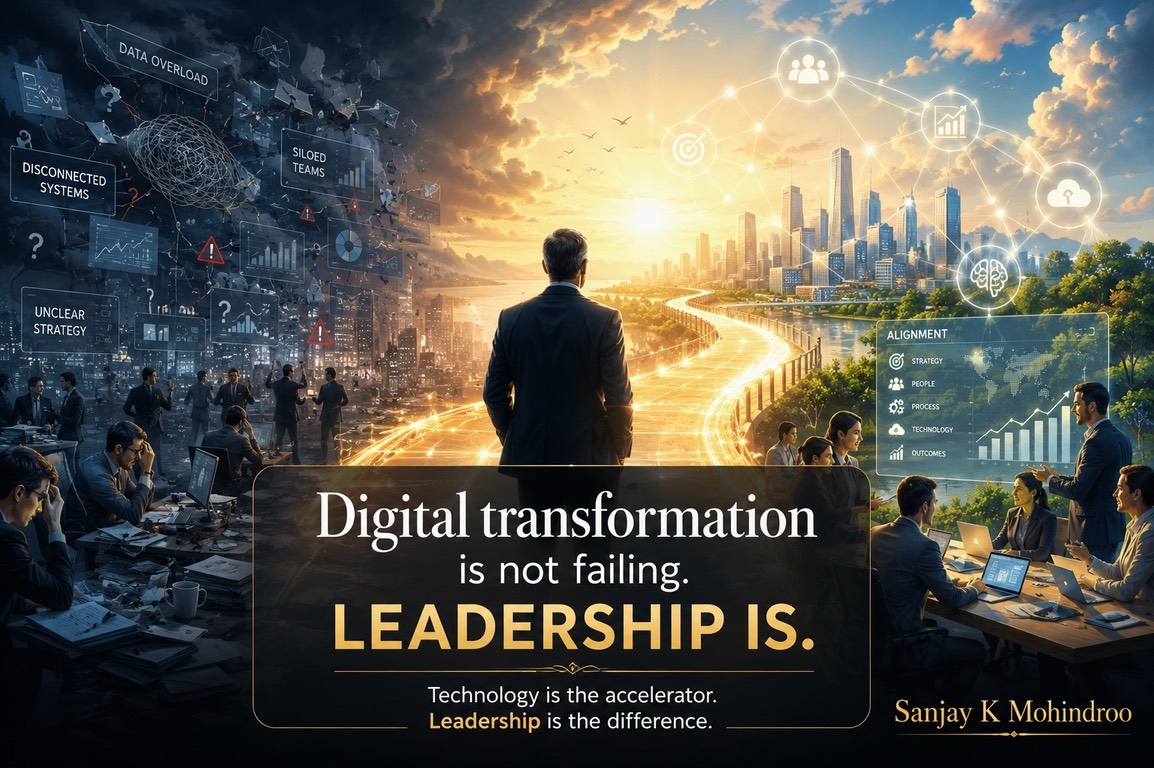
Digital transformation is not failing because of technology. It is failing because leadership models have not evolved. A senior IT leader’s perspective on what executives must change now.
Most digital transformation programs do not collapse because of weak technology. They collapse because leadership treats transformation as a technology initiative rather than a business reinvention.
After three decades leading global IT organizations, I have seen companies spend millions on cloud migrations, AI platforms, data lakes, and automation programs while ignoring the one variable that determines success: leadership behavior.
Technology changes fast. Human systems do not.
Boards demand innovation while rewarding predictability. Executives ask for agility while preserving rigid hierarchies. CIOs are expected to drive transformation while being excluded from core business decisions.
The result is familiar. Large investments. Endless dashboards. Very little meaningful change.
The companies getting digital transformation right are not necessarily the most advanced technically. They are the ones where leadership creates clarity, accountability, trust, and operational alignment.
That is the real transformation challenge.
#Leadership #DigitalTransformation #CIO
The Real Problem Was Never Technology
Most organizations already have enough tools
A few months ago, I sat with the executive team of a global enterprise that had invested heavily in digital modernization. Their stack looked impressive on paper.
Cloud platforms.
AI pilots.
Advanced analytics.
Automation tools.
Collaboration suites.
Yet revenue growth had stalled. Decision cycles were slow. Employees were frustrated. Customers still complained about inconsistent experiences.
The CEO asked a simple question:
“Why are we not seeing results?”
The answer was uncomfortable.
Because the company had modernized systems without modernizing leadership behavior.
This happens far more often than people admit.
Digital transformation is frequently treated like a procurement exercise. Buy new technology. Hire consultants. Launch a transformation office. Create impressive slides. Announce ambitious targets.
But transformation is not a software implementation project.
It is a leadership discipline.
Real transformation changes how decisions are made, how teams collaborate, how accountability works, and how quickly organizations respond to reality.
Technology only accelerates whatever leadership culture already exists.
If leadership is
fragmented, technology increases fragmentation.
If leadership is slow, technology increases operational complexity.
If leadership avoids accountability, transformation becomes theatre.
I have seen billion-dollar organizations behave like highly advanced startups. I have also seen companies with world-class technology move with the urgency of a fax machine.
The difference was never the platform.
It was leadership.
The Contrarian Truth
Digital transformation is not failing. Leadership is.
For years, the industry narrative has been that digital transformation programs fail because technology is difficult.
That is incomplete.
Technology is rarely the primary issue anymore. Most platforms are mature. Cloud infrastructure is reliable. AI capabilities are advancing rapidly. Data tools are more accessible than ever.
The real problem is that many leadership teams still operate with industrial-age thinking inside digital-age environments.
They want innovation without risk.
Speed without delegation.
Data-driven decisions without transparency.
Agility without changing power structures.
That combination does not work.
One of the biggest myths in corporate transformation is the belief that digital strategy can remain isolated within IT.
It cannot.
If operations resist change, transformation slows.
If finance measures only short-term cost savings, transformation stalls.
If HR does not evolve
workforce models, transformation weakens.
If leadership communication lacks clarity, transformation loses credibility.
This is why many “digital-first” organizations still behave like disconnected silos.
The technology moved forward.
The leadership mindset did not.
That is the gap no dashboard can hide.
#BusinessTransformation #ExecutiveLeadership
CIOs Must Stop Acting Like Technology Managers
The modern CIO is a business architect
The role of the CIO has changed permanently.
The organizations succeeding today no longer see the CIO as the person managing infrastructure and systems uptime. They see the CIO as a strategic operator shaping business resilience, customer experience, growth capability, and execution speed.
This shift matters.
Technology now
influences every major business outcome:
Revenue growth.
Operational efficiency.
Customer trust.
Risk management.
Market responsiveness.
Yet many CIOs still communicate in technical language while the board is discussing business outcomes.
That disconnect weakens influence.
The strongest technology leaders I have worked with do three things exceptionally well.
First, they simplify complexity.
Second, they connect
technology decisions directly to business value.
Third, they build trust across functions.
That last point is often underestimated.
Transformation succeeds when business leaders feel ownership, not dependency.
The CIO cannot operate as the “service provider” for the enterprise anymore. That model is outdated.
Today’s CIO must operate as a strategic peer to the CEO, COO, CFO, and board.
The conversation has shifted from:
“What technology should we buy?”
To:
“What business capability must we build?”
That is a very different discussion.
#CIO #TechnologyLeadership
Speed Is Now a Leadership Capability
Slow decision-making is becoming a competitive risk
Many organizations still underestimate the cost of internal delay.
I have watched companies spend six months debating decisions that startups execute in six days.
Markets do not wait for alignment workshops.
Customers do not care about internal governance structures.
And employees lose confidence when leadership hesitation becomes visible.
One hard truth I have learned over the years is this:
Organizations rarely move faster than their leadership comfort level.
When leadership fears failure, teams slow down.
When leadership avoids clarity, priorities multiply.
When leadership sends mixed signals, execution fragments.
Digital transformation is not just about adopting technology faster.
It is about reducing organizational friction.
That requires courage from leadership.
Not motivational speeches.
Not slogans.
Not another transformation committee.
Courage.
The courage to simplify.
The courage to decentralize decisions.
The courage to stop funding initiatives that create noise instead of value.
The best transformation programs I have seen were not the most complicated.
They were the clearest.
What leadership teams must confront now?
1. Technology cannot compensate for weak leadership alignment.
2. Transformation must be measured through business outcomes, not implementation milestones.
3. CIOs should participate in enterprise strategy discussions from the beginning, not after decisions are made.
4. Speed, clarity, and accountability are now competitive advantages.
5. AI and automation will amplify leadership quality, not replace it.
6. Transformation fatigue often signals communication failure, not employee resistance.
7. Culture is no longer a “soft” issue. It directly impacts execution capability.
The organizations that thrive over the next decade will not necessarily spend the most on technology.
They will lead differently.
#FutureOfWork #DigitalLeadership #EnterpriseTransformation
Digital transformation is entering a more honest phase.
The era of chasing technology trends without organizational accountability is ending.
Boards are asking harder questions.
Investors want measurable outcomes.
Employees expect clarity.
Customers expect consistency.
And leadership teams can no longer hide operational weakness behind transformation language.
That is a good thing.
Because the organizations that embrace this reality have an enormous opportunity ahead.
Technology is still a powerful accelerator.
AI will reshape industries.
Automation will redefine operations.
Data will influence every strategic decision.
But leadership remains the force multiplier.
Always has been.
The future will not belong to the companies with the most technology.
It will belong to the companies with the clearest leadership.
#DigitalTransformation #Leadership #CIO #BusinessTransformation #TechnologyLeadership #ExecutiveLeadership #EnterpriseTransformation #FutureOfWork #AI #DigitalStrategy #BoardLeadership #Innovation #BusinessStrategy #ITLeadership #OperationalExcellence